Ammonia 1NH32 has base dissociation constant 1Kb2 of
1.8 * 10-5. What is the concentration of an aqueous ammonia
solution that has a pH of 11.68? (LO 16.11)
(a) 0.28 M (b) 3.6 M
(c) 9.0 * 10-3 M (d) 1.3 M
Guida verificata passo dopo passo
1
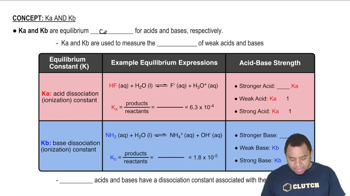
First, understand that ammonia (NH_3) is a weak base and its dissociation in water can be represented by the equation: NH_3 + H_2O \(\rightleftharpoons\) NH_4^+ + OH^-.
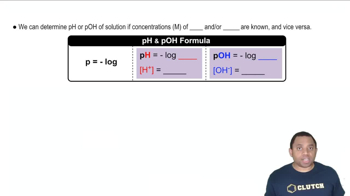
Next, use the given pH to find the pOH. Since pH + pOH = 14, calculate pOH = 14 - 11.68.
Convert the pOH to the hydroxide ion concentration [OH^-] using the formula: [OH^-] = 10^{-\(\text{pOH}\)}.
Apply the base dissociation constant (K_b) expression for ammonia: K_b = \(\frac{[NH_4^+][OH^-]}{[NH_3]}\). Since [NH_4^+] = [OH^-] at equilibrium, substitute [OH^-] into the K_b expression.
Rearrange the K_b expression to solve for the initial concentration of ammonia [NH_3]: [NH_3] = \(\frac{[OH^-]^2}{K_b}\).
Risposta video verificata per un problema simile:
Questa soluzione video è stata consigliata dai nostri tutor come utile per risolvere questo problema.
Durata del video:
7m
Guarda un video:
0 Commenti
Concetti chiave
Ecco i concetti essenziali che devi comprendere per rispondere correttamente alla domanda.
Base Dissociation Constant (Kb)
The base dissociation constant (Kb) quantifies the strength of a base in solution. It is defined as the equilibrium constant for the reaction in which a base accepts a proton from water, forming its conjugate acid and hydroxide ions. A higher Kb value indicates a stronger base, while a lower value suggests a weaker base. In this case, ammonia has a Kb of 1.8 x 10^-5, indicating it is a weak base.
pH is a measure of the acidity or basicity of a solution, defined as the negative logarithm of the hydrogen ion concentration. The pOH is similarly defined for hydroxide ions. The relationship between pH and pOH is given by the equation pH + pOH = 14 at 25°C. For a solution with a pH of 11.68, the pOH can be calculated, which is essential for determining the concentration of hydroxide ions in the solution.
The concentration of hydroxide ions ([OH-]) in a solution can be derived from the pOH value. Once the pOH is calculated from the pH, the concentration of hydroxide ions can be found using the formula [OH-] = 10^(-pOH). This concentration is crucial for applying the Kb expression to find the concentration of ammonia in the solution, as it relates to the equilibrium established when ammonia dissociates in water.