Aqueous solutions of hydrogen sulfide contain H2S, HS-,
S2-, H3O+ , OH-, and H2O in varying concentrations. Which
of these species can act only as an acid? Which can act only as
a base? Which can act both as an acid and as a base?
Guida verificata passo dopo passo
1
Identify the species present in the solution: \( \text{H}_2\text{S} \), \( \text{HS}^- \), \( \text{S}^{2-} \), \( \text{H}_3\text{O}^+ \), \( \text{OH}^- \), and \( \text{H}_2\text{O} \).
Recall the definitions of acids and bases according to the Brønsted-Lowry theory: an acid is a proton donor, and a base is a proton acceptor.
Determine which species can only donate protons (act only as acids): \( \text{H}_3\text{O}^+ \) is a strong acid and can only donate protons.
Determine which species can only accept protons (act only as bases): \( \text{S}^{2-} \) is a strong base and can only accept protons.
Identify species that can both donate and accept protons (act as both acids and bases): \( \text{H}_2\text{S} \), \( \text{HS}^- \), and \( \text{H}_2\text{O} \) can act as both acids and bases.
Risposta video verificata per un problema simile:
Questa soluzione video è stata consigliata dai nostri tutor come utile per risolvere questo problema.
Durata del video:
1m
Guarda un video:
0 Commenti
Concetti chiave
Ecco i concetti essenziali che devi comprendere per rispondere correttamente alla domanda.
Bronsted-Lowry Acid-Base Theory
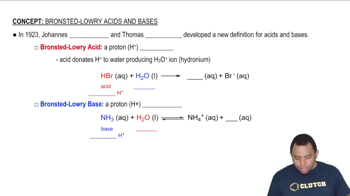
The Bronsted-Lowry theory defines acids as proton donors and bases as proton acceptors. In this context, species that can donate a hydrogen ion (H+) are classified as acids, while those that can accept a hydrogen ion are classified as bases. This theory helps in understanding the behavior of various species in aqueous solutions, particularly in identifying their roles in acid-base reactions.
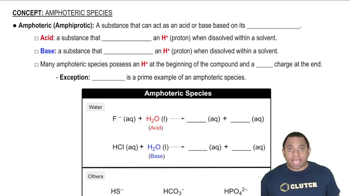
Amphoteric species are substances that can act as either an acid or a base depending on the circumstances. For example, water (H2O) can donate a proton to become hydroxide (OH-) or accept a proton to become hydronium (H3O+). Recognizing amphoteric behavior is crucial for determining which species can participate in both acid and base reactions in a solution.
In aqueous solutions, chemical species exist in dynamic equilibrium, meaning their concentrations can change based on reactions occurring in the solution. Understanding this equilibrium is essential for predicting how species like H2S, HS-, and S2- will behave as acids or bases, as well as how they interact with water and other ions present in the solution.


 Guida verificata passo dopo passo
 02:08
02:08