Ch.16 - Aqueous Equilibria: Acids & Bases
McMurry - Chemistry 8th Edition
McMurry8th EditionChemistryISBN: 9781292336145Non è quello che usi tu?Cambia libro di testo
Capitolo 16, Problema 60a

Arrange each group of compounds in order of increasing acid strength. Explain your reasoning. (a) HCl, H2S, PH3

Guida verificata passo dopo passo
1
Identify the type of compounds given: HCl (hydrochloric acid), H2S (hydrogen sulfide), and PH3 (phosphine). These are all binary acids, where acid strength is influenced by the electronegativity and size of the central atom.
Consider the periodic table trends: Electronegativity generally increases across a period and decreases down a group. Acid strength increases with increasing electronegativity of the central atom when comparing acids within the same period.
Analyze the position of the central atoms in the periodic table: Chlorine (Cl) is in the same period as sulfur (S) but is more electronegative. Phosphorus (P) is above sulfur in the same group and is less electronegative.
Compare the acid strength based on the size of the central atom: Larger atoms tend to have weaker H-X bonds, which can increase acid strength due to easier release of H+ ions. However, in this case, the effect of electronegativity is more dominant.
Conclude the order of increasing acid strength based on the above analysis: PH3 (weakest acid due to least electronegative and larger central atom), H2S, and HCl (strongest acid due to most electronegative central atom).

Risposta video verificata per un problema simile:

Questa soluzione video è stata consigliata dai nostri tutor come utile per risolvere questo problema.
Durata del video:
3m

Concetti chiave

Ecco i concetti essenziali che devi comprendere per rispondere correttamente alla domanda.

Acid Strength

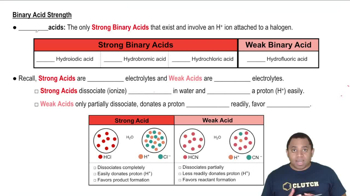
Acid strength refers to the ability of an acid to donate protons (H+) in a solution. Stronger acids dissociate more completely in water, resulting in a higher concentration of H+ ions. The strength of an acid is influenced by factors such as bond strength, electronegativity of the atoms involved, and the stability of the conjugate base formed after deprotonation.
Video consigliato:
Percorso guidato
03:51
Binary Acid Strengths

Electronegativity

Electronegativity is the tendency of an atom to attract electrons in a chemical bond. In the context of acids, higher electronegativity of the central atom typically leads to stronger acids, as it stabilizes the negative charge on the conjugate base after the acid donates a proton. For example, in the series HCl, H2S, and PH3, the electronegativity of chlorine is greater than that of sulfur and phosphorus, contributing to HCl's stronger acidic nature.
Video consigliato:
Percorso guidato
02:10
Electronegativity Trends

Conjugate Base Stability

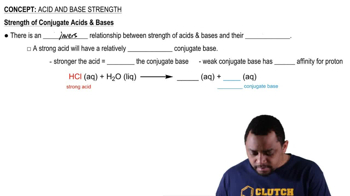
The stability of the conjugate base formed after an acid donates a proton is crucial in determining acid strength. A more stable conjugate base corresponds to a stronger acid, as the equilibrium favors the formation of the products. Factors affecting conjugate base stability include resonance, electronegativity, and the size of the atom bearing the negative charge. In the given compounds, the stability of the conjugate bases influences the order of acid strength.
Video consigliato:
Percorso guidato
00:50
Strength of Conjugate Acids and Bases