Ch.16 - Aqueous Equilibria: Acids & Bases
McMurry - Chemistry 8th Edition
McMurry8th EditionChemistryISBN: 9781292336145Non è quello che usi tu?Cambia libro di testo
Capitolo 16, Problema 109

Calculate the concentrations of H3O+ and SO4 2- in a solution prepared by mixing equal volumes of 0.2 M HCl and 0.6 M H2SO41Ka2 for H2SO4 is 1.2 * 10-22.

Guida verificata passo dopo passo
1
Determine the initial concentrations of HCl and H2SO4 in the mixed solution. Since equal volumes of 0.2 M HCl and 0.6 M H2SO4 are mixed, the concentration of each acid will be halved in the resulting solution.
Calculate the concentration of H3O+ contributed by the complete dissociation of HCl. HCl is a strong acid and dissociates completely into H3O+ and Cl-.
Consider the dissociation of H2SO4. The first dissociation of H2SO4 is also complete, contributing additional H3O+ ions and forming HSO4- ions.
Evaluate the second dissociation of H2SO4 using the given Ka2 value. Use the expression for the equilibrium constant, Ka2 = [H3O+][SO4 2-] / [HSO4-], to set up the equation to find the concentration of SO4 2-.
Sum up all the contributions of H3O+ from HCl and both steps of H2SO4 dissociation to find the total concentration of H3O+ in the solution.

Risposta video verificata per un problema simile:

Questa soluzione video è stata consigliata dai nostri tutor come utile per risolvere questo problema.
Durata del video:
10m

Concetti chiave

Ecco i concetti essenziali che devi comprendere per rispondere correttamente alla domanda.

Acid-Base Chemistry

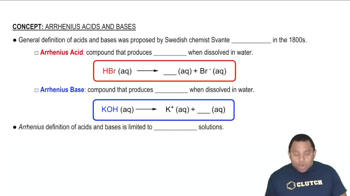
Acid-base chemistry involves the study of proton donors (acids) and proton acceptors (bases). In this context, HCl is a strong acid that completely dissociates in solution to produce H3O+ ions, while H2SO4 is a diprotic acid that can donate two protons. Understanding how these acids dissociate is crucial for calculating the concentrations of H3O+ and SO4^2- in the mixed solution.
Video consigliato:
Percorso guidato
02:00
Arrhenius Acids and Bases

Concentration and Dilution

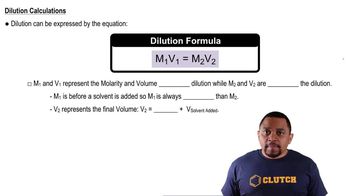
Concentration refers to the amount of solute present in a given volume of solution, typically expressed in molarity (M). When mixing solutions of different concentrations, the final concentration can be determined using the dilution equation, which accounts for the volumes and concentrations of the original solutions. This concept is essential for calculating the resulting concentrations after mixing HCl and H2SO4.
Video consigliato:
Percorso guidato
00:58
Dilution Equation

Equilibrium and Ka Values

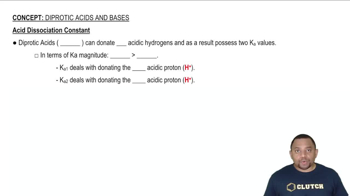
The acid dissociation constant (Ka) quantifies the strength of an acid in solution, indicating the extent to which it donates protons. For H2SO4, the first dissociation is strong, while the second dissociation is characterized by a much smaller Ka value (1.2 * 10^-22). Understanding these dissociation constants is vital for determining the concentrations of the resulting ions, such as SO4^2-, in the solution.
Video consigliato:
Percorso guidato
00:59
Ka values of Diprotic Acids