
Ch.16 - Aqueous Equilibria: Acids & Bases
McMurry - Chemistry 8th Edition
McMurry8th EditionChemistryISBN: 9781292336145Non è quello che usi tu?Cambia libro di testo
Capitolo 16, Problema 146

Calculate the pH and the concentrations of all species present (H3O+ , F-, HF, Cl-, and OH-) in a solution that contains 0.10 M HF 1Ka = 3.5 * 10-42 and 0.10 M HCl.

Guida verificata passo dopo passo
1
Identify the strong and weak acids in the solution. HCl is a strong acid, and HF is a weak acid.
Calculate the concentration of \( \text{H}_3\text{O}^+ \) from the complete dissociation of HCl, which is equal to its initial concentration, 0.10 M.
Use the initial concentration of HF and its \( K_a \) value to set up an equilibrium expression for the dissociation of HF: \( HF \rightleftharpoons H^+ + F^- \).
Assume the change in concentration of HF due to its dissociation is small compared to its initial concentration, and solve for \( [H^+] \) and \( [F^-] \) using the equilibrium expression.
Calculate the pH of the solution using the total \( [H^+] \) concentration, which is the sum of \( [H^+] \) from HCl and the small contribution from HF.

Risposta video verificata per un problema simile:

Questa soluzione video è stata consigliata dai nostri tutor come utile per risolvere questo problema.
Durata del video:
4m

Concetti chiave

Ecco i concetti essenziali che devi comprendere per rispondere correttamente alla domanda.

Acid-Base Equilibrium

Acid-base equilibrium refers to the balance between acids and bases in a solution, which is governed by the dissociation constants (Ka and Kb) of the acids and bases involved. In this case, HF is a weak acid that partially dissociates in water, while HCl is a strong acid that completely dissociates. Understanding how these acids interact in solution is crucial for calculating pH and the concentrations of various species.
Video consigliato:
Percorso guidato
6:47
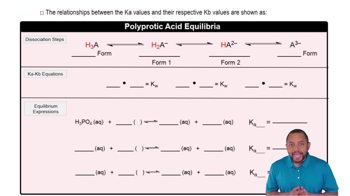
Triprotic Acid Equilibrium

pH Calculation

pH is a measure of the hydrogen ion concentration in a solution, defined as pH = -log[H3O+]. To calculate the pH of a solution containing both a weak acid (HF) and a strong acid (HCl), one must consider the contributions of both acids to the hydronium ion concentration. The strong acid will dominate the pH calculation due to its complete dissociation, but the weak acid's dissociation must also be accounted for.
Video consigliato:
Percorso guidato
02:15
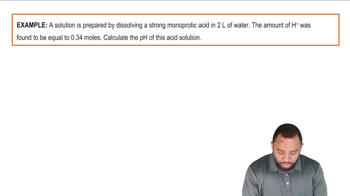
pH Calculation Example

Dissociation Constants (Ka)

The dissociation constant (Ka) quantifies the strength of an acid in solution, indicating the extent to which it donates protons (H+) to water. For HF, with a given Ka of 3.5 x 10^-4, this value helps determine the equilibrium concentrations of the species present in the solution. Understanding how to apply the Ka value in conjunction with the concentrations of the acids allows for the calculation of the concentrations of H3O+, F-, and other species in the solution.
Video consigliato:
Percorso guidato
03:50
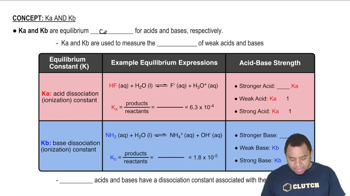
Characteristics of Ka and Kb