
Ch.16 - Aqueous Equilibria: Acids & Bases
McMurry - Chemistry 8th Edition
McMurry8th EditionChemistryISBN: 9781292336145Non è quello che usi tu?Cambia libro di testo
Capitolo 16, Problema 121

Using values of Ka in Appendix C, calculate values of Kb for each of the following ions. (a) Fluoride ion, F-

Guida verificata passo dopo passo
1
Identify the conjugate acid of the fluoride ion, F-. The conjugate acid of F- is HF (hydrofluoric acid).
Look up the acid dissociation constant (Ka) for HF in Appendix C of your textbook or a reliable chemistry resource.
Use the relationship between the acid dissociation constant (Ka) for the conjugate acid and the base dissociation constant (Kb) for the conjugate base. The relationship is given by the equation: Kb = Kw / Ka, where Kw is the ion-product constant of water at 25°C (approximately 1.0 x 10^-14).
Substitute the Ka value of HF into the equation to calculate Kb for the fluoride ion, F-.
Ensure all units are consistent and calculate Kb using appropriate scientific notation to express the small values typically found in dissociation constants.

Risposta video verificata per un problema simile:

Questa soluzione video è stata consigliata dai nostri tutor come utile per risolvere questo problema.
Durata del video:
1m

Concetti chiave

Ecco i concetti essenziali che devi comprendere per rispondere correttamente alla domanda.

Acid-Base Equilibrium

Acid-base equilibrium refers to the balance between acids and bases in a solution, characterized by the dissociation of acids into protons (H+) and their conjugate bases. The strength of an acid is quantified by its acid dissociation constant (Ka), while the strength of a base is measured by its base dissociation constant (Kb). Understanding this equilibrium is essential for calculating Kb from Ka values.
Video consigliato:
Percorso guidato
6:47
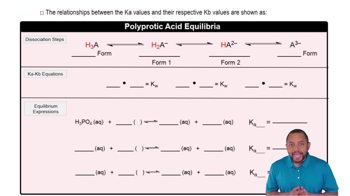
Triprotic Acid Equilibrium

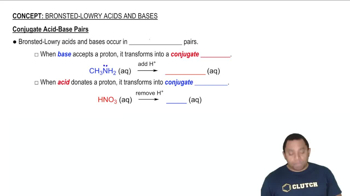
Conjugate Acid-Base Pairs

Conjugate acid-base pairs consist of an acid and its corresponding base that differ by a single proton. For example, when fluoride ion (F-) acts as a base, it can accept a proton to form its conjugate acid, HF. The relationship between Ka and Kb for a conjugate pair is given by the equation: Ka × Kb = Kw, where Kw is the ion product of water (1.0 x 10^-14 at 25°C).
Video consigliato:
Percorso guidato
01:30
Conjugate Acid-Base Pairs

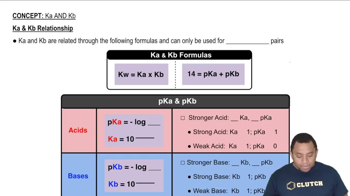
Calculating Kb from Ka

To calculate Kb from Ka, one can use the relationship between the two constants and the ion product of water. Specifically, Kb can be determined using the formula Kb = Kw / Ka. This calculation is crucial for determining the basicity of ions like fluoride, allowing for a deeper understanding of their behavior in aqueous solutions.
Video consigliato:
Percorso guidato
03:01
Ka and Kb Relationship