Ch.16 - Aqueous Equilibria: Acids & Bases
McMurry - Chemistry 8th Edition
McMurry8th EditionChemistryISBN: 9781292336145Non è quello che usi tu?Cambia libro di testo
Capitolo 16, Problema 41

Which of the following pictures represents a solution of a weak diprotic acid, H2A? (Water molecules have been omitted for clarity.) Which pictures represent an impossible situation? Explain.
Illustration of four scenarios depicting a weak diprotic acid solution, labeled a to d.
(a) (b) (c) (d)

Guida verificata passo dopo passo
1
Identify the species present in a solution of a weak diprotic acid, H2A. The possible species are H2A, HA^-, A^2-, and H3O^+.
Analyze each picture to determine which species are present. Picture (a) shows H2A, HA^-, and H3O^+. Picture (b) shows H2A, HA^-, and H3O^+. Picture (c) shows H2A, HA^-, and A^2-. Picture (d) shows H2A, HA^-, and H3O^+.
Determine which picture represents a solution of a weak diprotic acid. A weak diprotic acid will partially dissociate, so we should see a mixture of H2A, HA^-, and H3O^+.
Identify any impossible situations. Picture (c) is impossible because it shows the presence of A^2- without any H3O^+, which is not possible in a weak diprotic acid solution.
Conclude that pictures (a), (b), and (d) represent possible solutions of a weak diprotic acid, while picture (c) represents an impossible situation.

Risposta video verificata per un problema simile:

Questa soluzione video è stata consigliata dai nostri tutor come utile per risolvere questo problema.
Durata del video:
3m

Concetti chiave

Ecco i concetti essenziali che devi comprendere per rispondere correttamente alla domanda.

Diprotic Acids

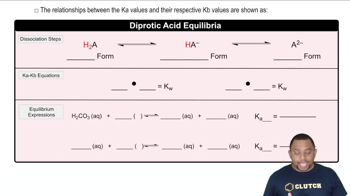
Diprotic acids are acids that can donate two protons (H⁺ ions) per molecule in a solution. The first dissociation typically produces a hydronium ion (H₃O⁺) and a conjugate base (HA⁻), while the second dissociation leads to the formation of another hydronium ion and a second conjugate base (A²⁻). Understanding the dissociation steps is crucial for analyzing the behavior of weak diprotic acids in solution.
Video consigliato:
Percorso guidato
04:40
3 forms of Diprotic Acids

Weak Acids

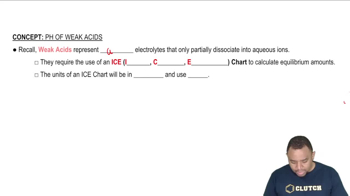
Weak acids are acids that do not completely dissociate in solution, meaning that a significant amount of the acid remains in its molecular form. This incomplete dissociation results in an equilibrium between the undissociated acid and its ions. The strength of a weak acid is often characterized by its acid dissociation constant (Ka), which indicates the extent of dissociation in solution.
Video consigliato:
Percorso guidato
00:44
ICE Charts of Weak Acids

Equilibrium in Acid-Base Reactions

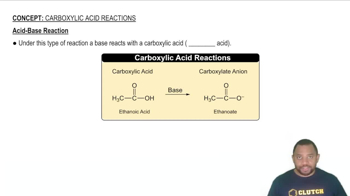
In acid-base reactions, equilibrium refers to the state where the rates of the forward and reverse reactions are equal, resulting in constant concentrations of reactants and products. For weak diprotic acids, this means that both the undissociated acid and its dissociated ions coexist in the solution. Analyzing the equilibrium helps determine which species are present and in what proportions, which is essential for identifying possible scenarios in the given question.
Video consigliato:
Percorso guidato
01:09
Acid-Base Reaction