Ch.16 - Aqueous Equilibria: Acids & Bases
McMurry - Chemistry 8th Edition
McMurry8th EditionChemistryISBN: 9781292336145Non è quello che usi tu?Cambia libro di testo
Capitolo 16, Problema 80

Which of the following species behave as strong acids or as strong bases in aqueous solution? (a) HNO2 (b) HNO3(c) NH4+ (d) Cl-

Guida verificata passo dopo passo
1
Identify if each species is an acid or a base. Acids donate protons (H+), while bases accept protons.
Determine the strength of the acids or bases. Strong acids completely dissociate in water, and strong bases completely dissociate to produce OH- ions.
Analyze each species: (a) HNO2 is nitrous acid, a known weak acid. (b) HNO3 is nitric acid, a known strong acid. (c) NH4+ is the ammonium ion, which can donate a proton and thus acts as a weak acid. (d) Cl- is the chloride ion, a very weak base and mostly a spectator ion in solution.
Conclude which species are strong acids or strong bases. From the analysis, only HNO3 is a strong acid.
Summarize that in the given options, HNO3 is the only species that behaves as a strong acid in aqueous solution, while the others are either weak acids or weak bases.

Risposta video verificata per un problema simile:

Questa soluzione video è stata consigliata dai nostri tutor come utile per risolvere questo problema.
Durata del video:
2m

Concetti chiave

Ecco i concetti essenziali che devi comprendere per rispondere correttamente alla domanda.

Strong Acids

Strong acids are substances that completely dissociate in water, releasing a high concentration of hydrogen ions (H+). This complete ionization results in a significant increase in the acidity of the solution. Common examples include hydrochloric acid (HCl) and nitric acid (HNO3), which is relevant to the question as it is one of the options listed.
Video consigliato:
Percorso guidato
01:09
Strong Acid-Strong Base Titration

Strong Bases

Strong bases are compounds that completely dissociate in aqueous solution to produce hydroxide ions (OH-). This complete dissociation leads to a high pH and strong basicity. Examples include sodium hydroxide (NaOH) and potassium hydroxide (KOH). Understanding which species act as strong bases is crucial for evaluating the options provided in the question.
Video consigliato:
Percorso guidato
01:09
Strong Acid-Strong Base Titration

Acid-Base Theory

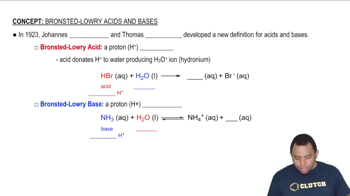
Acid-base theory encompasses various models, including the Brønsted-Lowry theory, which defines acids as proton donors and bases as proton acceptors. This theory helps in identifying the behavior of different species in solution. For instance, NH4+ can act as an acid by donating a proton, while Cl- is a neutral species that does not exhibit acidic or basic behavior.
Video consigliato:
Percorso guidato
02:08
Bronsted-Lowry Acid-Base Theory