Ch.17 - Applications of Aqueous Equilibria
McMurry - Chemistry 8th Edition
McMurry8th EditionChemistryISBN: 9781292336145Non è quello che usi tu?Cambia libro di testo
Capitolo 17, Problema 132

Can Fe2+ be separated from Sn2+ by bubbling H2S through a 0.3 M HCl solution that contains 0.01 M Fe2+ and 0.01 M Sn2+? A saturated solution of H2S has [H2S] ≈ 0.10 M. Values of Kspa are 6 x 10^2 for FeS andd 1 x 10^-5 for SnS.

Guida verificata passo dopo passo
1
Identify the relevant chemical reaction: When H2S is bubbled through the solution, it can react with metal ions to form metal sulfides. The reactions are: Fe^{2+} + S^{2-} \(\rightarrow\) FeS and Sn^{2+} + S^{2-} \(\rightarrow\) SnS.
Determine the solubility product expressions: The solubility product (K_{sp}) expressions for the sulfides are K_{sp,FeS} = [Fe^{2+}][S^{2-}] and K_{sp,SnS} = [Sn^{2+}][S^{2-}].
Calculate the concentration of S^{2-} ions: Use the dissociation of H2S in acidic solution. H2S \(\rightleftharpoons\) 2H^{+} + S^{2-}. The equilibrium expression is K_{a} = \(\frac{[H^{+}\)]^2[S^{2-}]}{[H2S]}.
Compare the ion product with K_{sp}: For each metal ion, calculate the ion product [M^{2+}][S^{2-}] and compare it with the respective K_{sp} to determine if precipitation occurs.
Analyze the results: If the ion product for SnS exceeds its K_{sp} while that for FeS does not, Sn^{2+} will precipitate as SnS, allowing separation from Fe^{2+}.

Risposta video verificata per un problema simile:

Questa soluzione video è stata consigliata dai nostri tutor come utile per risolvere questo problema.
Durata del video:
6m

Concetti chiave

Ecco i concetti essenziali che devi comprendere per rispondere correttamente alla domanda.

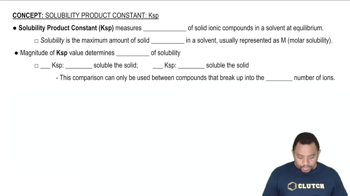
Solubility Product Constant (Ksp)

The solubility product constant (Ksp) is an equilibrium constant that applies to the solubility of sparingly soluble ionic compounds. It represents the product of the molar concentrations of the ions, each raised to the power of their coefficients in the balanced equation. For example, for the dissolution of FeS, Ksp = [Fe2+][S2-]. A higher Ksp indicates greater solubility, which is crucial for determining whether a precipitate will form when H2S is bubbled through the solution.
Video consigliato:
Percorso guidato
01:47
Solubility Product Constant

Precipitation Reaction

A precipitation reaction occurs when two soluble salts react to form an insoluble compound, or precipitate. In this scenario, H2S can react with Fe2+ and Sn2+ ions to form FeS and SnS, respectively. The formation of a precipitate depends on the concentration of the ions and the Ksp values of the resulting compounds. If the product of the ion concentrations exceeds the Ksp, a precipitate will form, allowing for the separation of the ions.
Video consigliato:
Percorso guidato
01:53
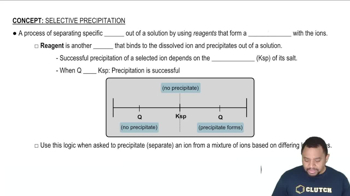
Selective Precipitation

Selective Precipitation

Selective precipitation is a technique used to separate ions in a solution based on their differing solubility products. By controlling the concentration of a precipitating agent, such as H2S, one can selectively precipitate one ion while leaving others in solution. In this case, the Ksp values for FeS and SnS indicate that FeS is more soluble than SnS, suggesting that under certain conditions, Fe2+ can remain in solution while Sn2+ precipitates, allowing for their separation.

Video consigliato:
Percorso guidato
01:53
Selective Precipitation