Ch.17 - Applications of Aqueous Equilibria
McMurry - Chemistry 8th Edition
McMurry8th EditionChemistryISBN: 9781292336145Non è quello che usi tu?Cambia libro di testo
Capitolo 17, Problema 126

Citric acid (H3Cit) can be used as a household cleaning agent to dissolve rust stains. The rust, represented as Fe(OH)3, dissolves because the citrate ion forms a soluble complex with Fe3+ (a) Using the equilibrium constants in Appendix C and Kf = 6.3 x 10^11 for Fe(Cit), calculate the equilibrium constant K for the reaction. (b) Calculate the molar solubility of Fe(OH)3 in 0.500 M solution of H3Cit.

Guida verificata passo dopo passo
1
Step 1: Identify the reactions involved. The dissolution of Fe(OH)3 can be represented as: Fe(OH)3(s) ⇌ Fe3+(aq) + 3OH-(aq). The formation of the soluble complex can be represented as: Fe3+(aq) + Cit3-(aq) ⇌ Fe(Cit)(aq).
Step 2: Combine these two reactions to get the overall reaction: Fe(OH)3(s) + Cit3-(aq) ⇌ Fe(Cit)(aq) + 3OH-(aq).
Step 3: Use the equilibrium constants given in the problem to calculate the equilibrium constant for the overall reaction. The equilibrium constant for the overall reaction, K, is the product of the equilibrium constant for the dissolution of Fe(OH)3, Ksp, and the formation constant for Fe(Cit), Kf.
Step 4: For part (b), use the equilibrium constant K and the concentration of H3Cit to calculate the molar solubility of Fe(OH)3. The molar solubility is the concentration of Fe3+ at equilibrium, which can be found by setting up and solving an equilibrium expression using the equilibrium constant K and the initial concentrations of the reactants and products.
Step 5: Remember that the concentration of Cit3- is equal to the concentration of H3Cit, since each molecule of H3Cit can donate three Cit3- ions. Also, the concentration of OH- is three times the concentration of Fe3+, since each molecule of Fe(OH)3 produces three OH- ions for every Fe3+ ion.

Risposta video verificata per un problema simile:

Questa soluzione video è stata consigliata dai nostri tutor come utile per risolvere questo problema.
Durata del video:
10m

Concetti chiave

Ecco i concetti essenziali che devi comprendere per rispondere correttamente alla domanda.

Equilibrium Constants

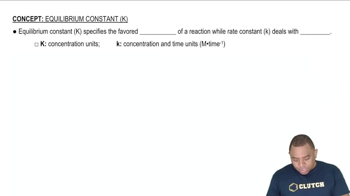
Equilibrium constants (K) quantify the ratio of concentrations of products to reactants at equilibrium for a given reaction. They are crucial for understanding how changes in concentration, temperature, or pressure affect the position of equilibrium. In this context, the equilibrium constant for the dissolution of Fe(OH)3 and its complexation with citrate ions is essential for calculating the solubility and the overall reaction dynamics.
Video consigliato:
Percorso guidato
01:14
Equilibrium Constant K

Complex Ion Formation

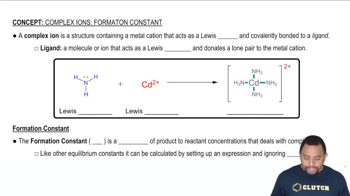
Complex ion formation occurs when a metal ion binds to one or more ligands, resulting in a stable complex. In this case, the citrate ion (Cit3-) acts as a ligand that binds to Fe3+, forming the complex Fe(Cit). The stability of this complex, indicated by the formation constant (Kf), significantly influences the solubility of Fe(OH)3 in the presence of citric acid, as it effectively reduces the concentration of free Fe3+ ions in solution.
Video consigliato:
Percorso guidato
02:20
Complex Ions and Formation Constant

Molar Solubility

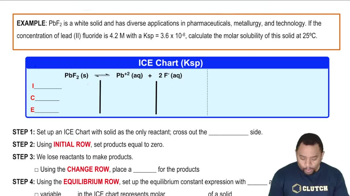
Molar solubility refers to the maximum concentration of a solute that can dissolve in a given volume of solvent at equilibrium. It is influenced by factors such as the presence of other ions or molecules in solution, which can shift the equilibrium. In this scenario, calculating the molar solubility of Fe(OH)3 in a 0.500 M H3Cit solution requires understanding how the citrate ions affect the dissolution of rust by complexing with Fe3+ ions.
Video consigliato:
Percorso guidato
04:13
Molar Solubility Example