
Ch.17 - Applications of Aqueous Equilibria
McMurry - Chemistry 8th Edition
McMurry8th EditionChemistryISBN: 9781292336145Non è quello che usi tu?Cambia libro di testo
Capitolo 17, Problema 85

Consider the titration of 40.0 mL of 0.250 M HF with 0.200 M NaOH. How many milliliters of base are required to reach the equivalence point? Calculate the pH at each of the following points. (d) After the addition of 80.0 mL of base

Guida verificata passo dopo passo
1
Identify the reaction: HF (weak acid) reacts with NaOH (strong base) to form NaF and water.
Calculate the moles of HF initially present using the formula: moles = concentration \( \times \) volume.
Determine the moles of NaOH added using the formula: moles = concentration \( \times \) volume.
Calculate the moles of HF remaining and the moles of F\(^-\) formed after the reaction.
Use the Henderson-Hasselbalch equation to find the pH: \( \text{pH} = \text{pK}_a + \log \left( \frac{[\text{F}^-]}{[\text{HF}]} \right) \), where \( \text{pK}_a \) is the negative logarithm of the acid dissociation constant of HF.

Risposta video verificata per un problema simile:

Questa soluzione video è stata consigliata dai nostri tutor come utile per risolvere questo problema.
Durata del video:
7m

Concetti chiave

Ecco i concetti essenziali che devi comprendere per rispondere correttamente alla domanda.

Titration and Equivalence Point

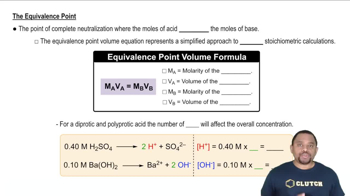
Titration is a quantitative analytical method used to determine the concentration of a solute in a solution. The equivalence point occurs when the amount of titrant added is stoichiometrically equivalent to the amount of analyte in the solution. In this case, it is the point where all the HF has reacted with NaOH, allowing for the calculation of the required volume of NaOH to reach this point.
Video consigliato:
Percorso guidato
03:06
Equivalence Point in Titration

Acid-Base Neutralization Reaction

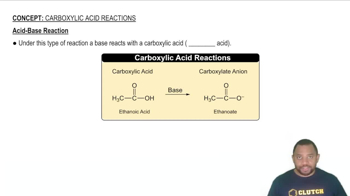
An acid-base neutralization reaction involves the reaction between an acid and a base to produce water and a salt. In this scenario, HF (a weak acid) reacts with NaOH (a strong base) to form water and sodium fluoride. Understanding the stoichiometry of this reaction is essential for calculating the volume of NaOH needed to neutralize the HF.
Video consigliato:
Percorso guidato
01:09
Acid-Base Reaction

pH Calculation

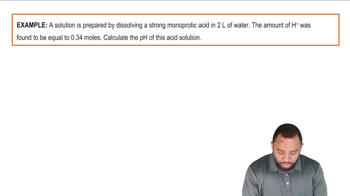
pH is a measure of the acidity or basicity of a solution, defined as the negative logarithm of the hydrogen ion concentration. After the addition of a specific volume of NaOH, the pH can be calculated based on the resulting concentrations of the remaining acid and the produced salt. At the equivalence point, the pH will be determined by the hydrolysis of the salt formed, while beyond this point, the solution will be basic due to excess NaOH.
Video consigliato:
Percorso guidato
02:15
pH Calculation Example