
Ch.17 - Applications of Aqueous Equilibria
McMurry - Chemistry 8th Edition
McMurry8th EditionChemistryISBN: 9781292336145Non è quello che usi tu?Cambia libro di testo
Capitolo 17, Problema 97a,c

Consider the titration of 50.0 mL of 1.00 M H3PO4 with 1.00 M KOH. Calculate the pH after the addition of each of the following volumes of base. (a) 25.0 mL (c) 75.0 mL

Guida verificata passo dopo passo
1
Identify the reaction between H3PO4 (phosphoric acid) and KOH (potassium hydroxide). The reaction is H3PO4 + KOH ightarrow KH2PO4 + H2O, where H3PO4 loses one proton to form KH2PO4.
Calculate the initial moles of H3PO4 and KOH. Since the concentration of H3PO4 is 1.00 M and the volume is 50.0 mL, the moles of H3PO4 are 0.0500 mol. For KOH, with 25.0 mL at 1.00 M, the moles are 0.0250 mol.
Determine the limiting reactant. In this case, KOH is the limiting reactant because there are fewer moles of KOH than H3PO4.
Calculate the moles of H3PO4 remaining after the reaction. Subtract the moles of KOH from the moles of H3PO4 to find the moles of unreacted H3PO4, which will be 0.0250 mol.
Calculate the concentration of the remaining H3PO4 and the formed KH2PO4 in the solution. The total volume of the solution after adding KOH is 75.0 mL. Use this volume to find the concentrations and then use the dissociation constant (Ka) of H3PO4 to find the pH of the solution.

Risposta video verificata per un problema simile:

Questa soluzione video è stata consigliata dai nostri tutor come utile per risolvere questo problema.
Durata del video:
6m

Concetti chiave

Ecco i concetti essenziali che devi comprendere per rispondere correttamente alla domanda.

Titration

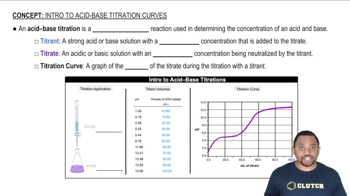
Titration is a quantitative analytical technique used to determine the concentration of a solute in a solution. It involves the gradual addition of a titrant (in this case, KOH) to a solution of analyte (H3PO4) until the reaction reaches its equivalence point, where stoichiometrically equivalent amounts of acid and base have reacted. The pH changes during this process can be monitored to determine the endpoint.
Video consigliato:
Percorso guidato
03:04
Acid-Base Titration

Acid-Base Neutralization

Acid-base neutralization is a chemical reaction between an acid and a base that produces water and a salt. In this titration, H3PO4, a triprotic acid, reacts with KOH, a strong base. The reaction can be represented as H3PO4 + KOH → K2H2PO4 + H2O, and understanding the stoichiometry of this reaction is crucial for calculating the resulting pH after specific volumes of KOH are added.
Video consigliato:
Percorso guidato
05:04
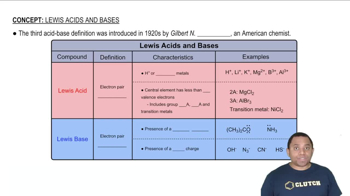
Lewis Acids and Bases

pH Calculation

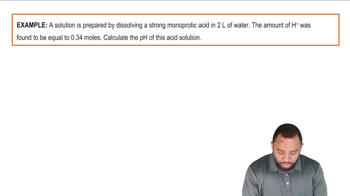
pH is a measure of the acidity or basicity of a solution, defined as the negative logarithm of the hydrogen ion concentration (pH = -log[H+]). In titrations, the pH can change significantly depending on the amount of acid and base present. After adding a specific volume of KOH, the pH can be calculated using the concentrations of the remaining acid and the produced salt, as well as the dissociation of water, especially near the equivalence point.
Video consigliato:
Percorso guidato
02:15
pH Calculation Example