
Ch.17 - Applications of Aqueous Equilibria
McMurry - Chemistry 8th Edition
McMurry8th EditionChemistryISBN: 9781292336145Non è quello che usi tu?Cambia libro di testo
Capitolo 17, Problema 95b,c

Consider the titration of 50.0 mL of a 0.100 M solution of the protonated form of the amino acid alanine (H2A+: Ka1 = 4.6 × 10⁻³, Ka2 = 2.0 × 10⁻¹⁰) with 0.100 M NaOH. Calculate the pH after the addition of each of the following volumes of base. (b) 25.0 mL (c) 50.0 mL

Guida verificata passo dopo passo
1
Determine the initial moles of H2A+ in the solution by multiplying the volume (50.0 mL) by the concentration (0.100 M). Convert the volume to liters before multiplying.
Calculate the moles of NaOH added by multiplying the volume of NaOH added (25.0 mL for part b and 50.0 mL for part c) by its concentration (0.100 M). Convert the volume to liters before multiplying.
For part (b), compare the moles of NaOH added to the initial moles of H2A+. Since 25.0 mL of NaOH is added, it is half the equivalence point, and the solution is a buffer. Use the Henderson-Hasselbalch equation to find the pH, considering the first dissociation (Ka1).
For part (c), since 50.0 mL of NaOH is added, it reaches the first equivalence point where all H2A+ is converted to HA. Calculate the pH by considering the hydrolysis of HA using the second dissociation constant (Ka2) and the concentration of HA at this point.
Use the appropriate equilibrium expressions and assumptions to solve for the pH in each case, ensuring to check if any simplifications can be made based on the relative magnitudes of Ka1 and Ka2.

Risposta video verificata per un problema simile:

Questa soluzione video è stata consigliata dai nostri tutor come utile per risolvere questo problema.
Durata del video:
23m

Concetti chiave

Ecco i concetti essenziali che devi comprendere per rispondere correttamente alla domanda.

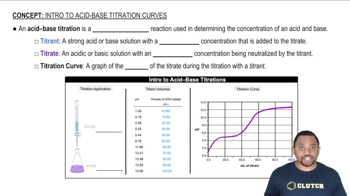
Titration

Titration is a quantitative analytical technique used to determine the concentration of a solute in a solution. It involves the gradual addition of a titrant (a solution of known concentration) to a sample until a reaction is complete, indicated by a color change or a pH change. In this case, the titration of alanine with NaOH will help determine the pH at specific volumes of base added.
Video consigliato:
Percorso guidato
03:04
Acid-Base Titration

Acid-Base Equilibria

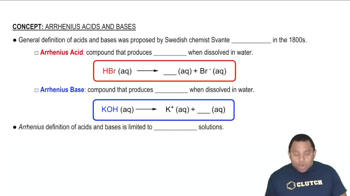
Acid-base equilibria involve the balance between proton donors (acids) and proton acceptors (bases) in a solution. The dissociation constants (Ka) of the amino acid alanine indicate its ability to donate protons at different pH levels. Understanding these equilibria is crucial for calculating the pH during titration, especially when determining the point at which the amino acid transitions from its protonated to deprotonated forms.
Video consigliato:
Percorso guidato
02:00
Arrhenius Acids and Bases

Henderson-Hasselbalch Equation

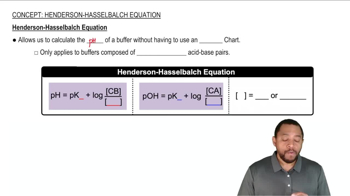
The Henderson-Hasselbalch equation is a mathematical formula used to calculate the pH of a buffer solution based on the concentration of the acid and its conjugate base. It is expressed as pH = pKa + log([A-]/[HA]). This equation is particularly useful in titration problems involving weak acids and their conjugate bases, such as alanine, as it allows for the determination of pH at various stages of the titration process.
Video consigliato:
Percorso guidato
02:40
Henderson-Hasselbalch Equation