
Ch.17 - Applications of Aqueous Equilibria
McMurry - Chemistry 8th Edition
McMurry8th EditionChemistryISBN: 9781292336145Non è quello che usi tu?Cambia libro di testo
Capitolo 17, Problema 53

The equilibrium constant Kn for the neutralization of lactic acid (C3H6O3) and urea (CH4N2O) is 2.1 x 10^-4. What is Kb for urea? The Ka of lactic acid is 1.4 x 10^-4.

Guida verificata passo dopo passo
1
Identify the reaction involved in the neutralization of lactic acid (C_3H_6O_3) with urea (CH_4N_2O). Neutralization typically involves an acid and a base reacting to form water and a salt.
Recognize that the equilibrium constant for the neutralization reaction (K_n) is related to the acid dissociation constant (K_a) of lactic acid and the base dissociation constant (K_b) of urea by the equation: K_n = K_w / (K_a * K_b), where K_w is the ion-product constant of water (1.0 x 10^-14 at 25°C).
Rearrange the equation to solve for K_b: K_b = K_w / (K_n * K_a).
Substitute the given values into the equation: K_w = 1.0 x 10^-14, K_n = 2.1 x 10^-4, and K_a = 1.4 x 10^-4.
Calculate K_b using the rearranged equation to find the base dissociation constant for urea.

Risposta video verificata per un problema simile:

Questa soluzione video è stata consigliata dai nostri tutor come utile per risolvere questo problema.
Durata del video:
1m

Concetti chiave

Ecco i concetti essenziali che devi comprendere per rispondere correttamente alla domanda.

Acid-Base Equilibrium

Acid-base equilibrium refers to the state in which the rates of the forward and reverse reactions of an acid and a base are equal, resulting in constant concentrations of reactants and products. In this context, the equilibrium constant (K) quantifies the ratio of the concentrations of products to reactants at equilibrium, providing insight into the strength of acids and bases involved in the reaction.
Video consigliato:
Percorso guidato
6:47
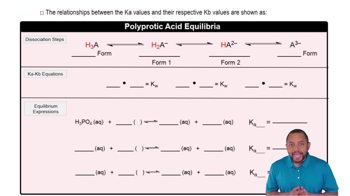
Triprotic Acid Equilibrium

Dissociation Constants (Ka and Kb)

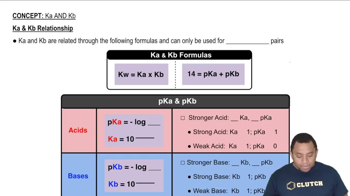
Dissociation constants, Ka and Kb, measure the strength of acids and bases, respectively. Ka represents the equilibrium constant for the dissociation of an acid into its conjugate base and hydrogen ions, while Kb represents the dissociation of a base into its conjugate acid and hydroxide ions. The relationship between Ka and Kb for a conjugate acid-base pair is given by the equation Kw = Ka × Kb, where Kw is the ion product of water.
Video consigliato:
Percorso guidato
03:01
Ka and Kb Relationship

Neutralization Reaction

A neutralization reaction occurs when an acid reacts with a base to produce water and a salt. In this case, lactic acid (an acid) reacts with urea (a base), and the equilibrium constant for this reaction indicates the extent to which the products are favored over the reactants. Understanding the equilibrium constant helps in calculating the Kb for urea using the given Ka for lactic acid and the relationship between the constants.
Video consigliato:
Percorso guidato
05:56
Lewis Dot Structures: Neutral Compounds