
Ch.17 - Applications of Aqueous Equilibria
McMurry - Chemistry 8th Edition
McMurry8th EditionChemistryISBN: 9781292336145Non è quello che usi tu?Cambia libro di testo
Capitolo 17, Problema 71

Use the Henderson–Hasselbalch equation to calculate the pH of a buffer solution that is 0.25 M in formic acid (HCO2H) and 0.50 M in sodium formate (HCO2Na).

Guida verificata passo dopo passo
1
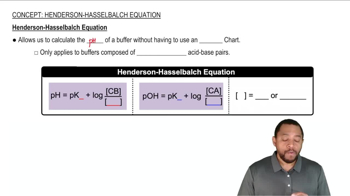
First, understand that the Henderson-Hasselbalch equation is given by: pH = pKa + log([A-]/[HA]), where [A-] is the concentration of the base (in this case, sodium formate) and [HA] is the concentration of the acid (in this case, formic acid).
Next, look up the pKa of formic acid. This is a constant value that is specific to each acid and can be found in a chemistry reference book or online.
Then, substitute the given values into the Henderson-Hasselbalch equation. The pKa is the value you looked up, [A-] is the concentration of sodium formate (0.50 M), and [HA] is the concentration of formic acid (0.25 M).
Now, calculate the value of the log([A-]/[HA]) term. This is done by dividing the concentration of the base by the concentration of the acid and taking the logarithm (base 10) of the result.
Finally, add the pKa to the result from step 4 to find the pH of the buffer solution. This is the final step in using the Henderson-Hasselbalch equation to calculate the pH of a buffer solution.

Risposta video verificata per un problema simile:

Questa soluzione video è stata consigliata dai nostri tutor come utile per risolvere questo problema.
Durata del video:
1m

Concetti chiave

Ecco i concetti essenziali che devi comprendere per rispondere correttamente alla domanda.

Henderson-Hasselbalch Equation

The Henderson-Hasselbalch equation is a mathematical formula used to calculate the pH of a buffer solution. It is expressed as pH = pKa + log([A-]/[HA]), where pKa is the negative logarithm of the acid dissociation constant (Ka) of the weak acid, [A-] is the concentration of the conjugate base, and [HA] is the concentration of the weak acid. This equation highlights the relationship between the pH of a solution and the ratio of the concentrations of the acid and its conjugate base.
Video consigliato:
Percorso guidato
02:40
Henderson-Hasselbalch Equation

Buffer Solutions

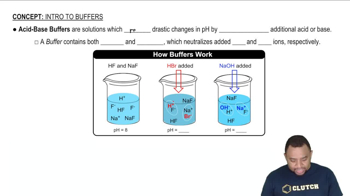
Buffer solutions are mixtures that resist changes in pH when small amounts of acid or base are added. They typically consist of a weak acid and its conjugate base, or a weak base and its conjugate acid. In this case, formic acid (HCO2H) acts as the weak acid, while sodium formate (HCO2Na) serves as its conjugate base. Buffers are crucial in biological and chemical systems where maintaining a stable pH is essential.
Video consigliato:
Percorso guidato
03:02
Buffer Solutions

Acid-Base Equilibrium

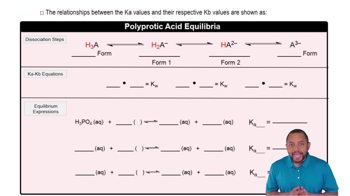
Acid-base equilibrium refers to the balance between the concentrations of acids and bases in a solution. In the context of the Henderson-Hasselbalch equation, this equilibrium is represented by the dissociation of the weak acid into its ions. Understanding this equilibrium is vital for calculating pH, as it determines how the addition of acids or bases will affect the overall pH of the buffer solution.
Video consigliato:
Percorso guidato
6:47
Triprotic Acid Equilibrium