Ch.17 - Applications of Aqueous Equilibria
McMurry - Chemistry 8th Edition
McMurry8th EditionChemistryISBN: 9781292336145Non è quello che usi tu?Cambia libro di testo
Capitolo 17, Problema 108

Use the values of Ksp in Appendix C to calculate the solubility of the following compounds (in g/L): (c) Cu3(PO4)2

Guida verificata passo dopo passo
1
Identify the chemical formula of the compound: \( \text{Cu}_3(\text{PO}_4)_2 \).
Write the dissolution equation for \( \text{Cu}_3(\text{PO}_4)_2 \) in water: \( \text{Cu}_3(\text{PO}_4)_2 (s) \rightleftharpoons 3\text{Cu}^{2+} (aq) + 2\text{PO}_4^{3-} (aq) \).
Express the solubility product constant \( K_{sp} \) in terms of the concentrations of the ions: \( K_{sp} = [\text{Cu}^{2+}]^3 [\text{PO}_4^{3-}]^2 \).
Let the molar solubility of \( \text{Cu}_3(\text{PO}_4)_2 \) be \( s \). Then, \([\text{Cu}^{2+}] = 3s\) and \([\text{PO}_4^{3-}] = 2s\).
Substitute \([\text{Cu}^{2+}] = 3s\) and \([\text{PO}_4^{3-}] = 2s\) into the \( K_{sp} \) expression and solve for \( s \). Convert \( s \) to solubility in g/L using the molar mass of \( \text{Cu}_3(\text{PO}_4)_2 \).

Risposta video verificata per un problema simile:

Questa soluzione video è stata consigliata dai nostri tutor come utile per risolvere questo problema.
Durata del video:
8m

Concetti chiave

Ecco i concetti essenziali che devi comprendere per rispondere correttamente alla domanda.

Solubility Product Constant (Ksp)

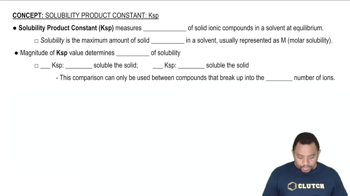
The solubility product constant (Ksp) is an equilibrium constant that quantifies the solubility of a sparingly soluble ionic compound. It is defined as the product of the molar concentrations of the ions, each raised to the power of their coefficients in the balanced dissolution equation. For example, for Cu3(PO4)2, Ksp can be expressed as [Cu^2+]^3[PO4^3-]^2, where the concentrations of copper and phosphate ions are used to calculate the solubility.
Video consigliato:
Percorso guidato
01:47
Solubility Product Constant

Dissolution Equilibrium

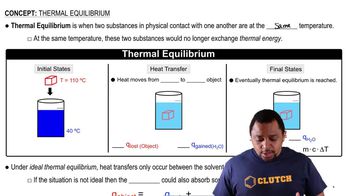
Dissolution equilibrium refers to the dynamic balance between the solid phase of a compound and its ions in solution. When a solid dissolves, it dissociates into its constituent ions, and the rate of dissolution equals the rate of precipitation at equilibrium. Understanding this concept is crucial for calculating solubility, as it allows us to relate the concentrations of ions in solution to the Ksp value.
Video consigliato:
Percorso guidato
02:35
Thermal Equilibrium

Stoichiometry in Solubility Calculations

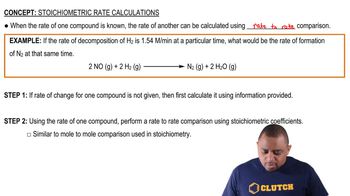
Stoichiometry involves the quantitative relationships between the amounts of reactants and products in a chemical reaction. In solubility calculations, it is essential to use the stoichiometric coefficients from the balanced dissolution equation to determine the molar concentrations of ions produced from a given amount of solute. For Cu3(PO4)2, the stoichiometry indicates that three moles of Cu^2+ and two moles of PO4^3- are produced for every mole of the compound that dissolves, which is vital for calculating its solubility.
Video consigliato:
Percorso guidato
02:28
Stoichiometric Rate Calculations