
Ch.17 - Applications of Aqueous Equilibria
McMurry - Chemistry 8th Edition
McMurry8th EditionChemistryISBN: 9781292336145Non è quello che usi tu?Cambia libro di testo
Capitolo 17, Problema 5

Which is the best acid-base pair to use in the preparation of a buffer with pH = 10.5? (a) HOI and OI- (Ka = 2.0 x 10^-11) (b) HNO2 and NO2- (Ka = 4.5 x 10^-4) (c) HIO3 and IO3- (Ka = 1.7 x 10^-1) (d) H2PO4^- and HPO4^2- (Ka = 6.2 x 10^-8)

Guida verificata passo dopo passo
1
Step 1: Understand that a buffer solution is most effective when the pH is close to the pKa of the acid in the acid-base pair.
Step 2: Calculate the pKa for each acid using the formula pKa = -log(Ka).
Step 3: Compare the calculated pKa values to the desired pH of 10.5.
Step 4: Identify the acid-base pair whose pKa is closest to the desired pH of 10.5.
Step 5: Select the acid-base pair with the pKa closest to 10.5 as the best choice for the buffer solution.

Concetti chiave

Ecco i concetti essenziali che devi comprendere per rispondere correttamente alla domanda.

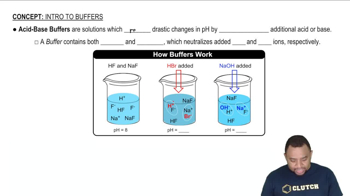
Buffer Solutions

A buffer solution is a system that resists changes in pH upon the addition of small amounts of acid or base. It typically consists of a weak acid and its conjugate base or a weak base and its conjugate acid. The effectiveness of a buffer is determined by the pKa of the acid and the desired pH, which should be close to the pKa for optimal buffering capacity.
Video consigliato:
Percorso guidato
03:02
Buffer Solutions

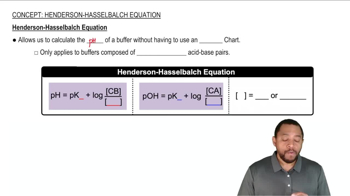
Henderson-Hasselbalch Equation

The Henderson-Hasselbalch equation relates the pH of a buffer solution to the pKa of the acid and the ratio of the concentrations of the conjugate base to the weak acid. It is expressed as pH = pKa + log([A-]/[HA]). This equation is crucial for determining the appropriate acid-base pair to achieve a specific pH, such as 10.5 in this case.
Video consigliato:
Percorso guidato
02:40
Henderson-Hasselbalch Equation

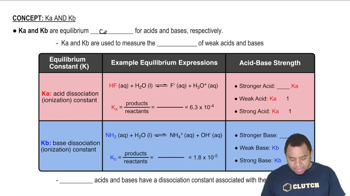
Acid Dissociation Constant (Ka)

The acid dissociation constant (Ka) quantifies the strength of an acid in solution, indicating how well it donates protons (H+) to the solution. A higher Ka value corresponds to a stronger acid, which is more effective at maintaining the desired pH in a buffer. When selecting an acid-base pair for a buffer, the pKa (the negative logarithm of Ka) should be close to the target pH for optimal performance.
Video consigliato:
Percorso guidato
03:50
Characteristics of Ka and Kb