Ch.17 - Applications of Aqueous Equilibria
McMurry - Chemistry 8th Edition
McMurry8th EditionChemistryISBN: 9781292336145Non è quello che usi tu?Cambia libro di testo
Capitolo 17, Problema 65

Which of the following solutions has the greater buffer capacity: 100 mL of 0.30 M HNO2-0.30 M NaNO2 or 100 mL of 0.10 M HNO2-0.10 M NaNO2? Explain.

Guida verificata passo dopo passo
1
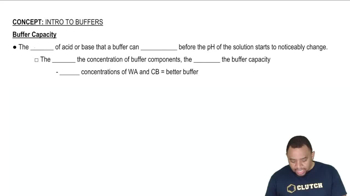
Step 1: Understand the concept of buffer capacity. Buffer capacity refers to the amount of acid or base that can be added to a buffer solution before its pH starts to change significantly. It is directly proportional to the concentrations of the weak acid and its conjugate base (or the weak base and its conjugate acid) in the buffer solution.
Step 2: Identify the components of the buffer solutions. In both solutions, HNO2 is the weak acid and NaNO2 is the salt of its conjugate base, NO2-. The concentrations of HNO2 and NO2- are equal in each solution.
Step 3: Compare the concentrations of the buffer components in the two solutions. The first solution has a concentration of 0.30 M for both HNO2 and NO2-, while the second solution has a concentration of 0.10 M for both.
Step 4: Apply the concept of buffer capacity. Since buffer capacity is directly proportional to the concentrations of the buffer components, the solution with the higher concentrations of HNO2 and NO2- will have the greater buffer capacity.
Step 5: Conclude that the 100 mL of 0.30 M HNO2-0.30 M NaNO2 solution has the greater buffer capacity because it has higher concentrations of the buffer components than the 100 mL of 0.10 M HNO2-0.10 M NaNO2 solution.

Risposta video verificata per un problema simile:

Questa soluzione video è stata consigliata dai nostri tutor come utile per risolvere questo problema.
Durata del video:
2m

Concetti chiave

Ecco i concetti essenziali che devi comprendere per rispondere correttamente alla domanda.

Buffer Capacity

Buffer capacity refers to the ability of a buffer solution to resist changes in pH upon the addition of small amounts of acid or base. It is determined by the concentrations of the weak acid and its conjugate base present in the solution. A higher concentration of these components results in a greater buffer capacity, allowing the solution to maintain a stable pH more effectively.
Video consigliato:
Percorso guidato
00:45
Buffer Capacity

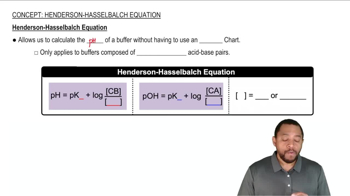
Henderson-Hasselbalch Equation

The Henderson-Hasselbalch equation is a mathematical formula used to calculate the pH of a buffer solution. It is expressed as pH = pKa + log([A-]/[HA]), where [A-] is the concentration of the conjugate base and [HA] is the concentration of the weak acid. This equation highlights the relationship between the concentrations of the acid and base in determining the pH and, consequently, the buffer capacity.
Video consigliato:
Percorso guidato
02:40
Henderson-Hasselbalch Equation

Concentration of Buffer Components

The concentration of buffer components, specifically the weak acid and its conjugate base, directly influences the buffer's effectiveness. In the given question, the first solution has a higher concentration (0.30 M) compared to the second solution (0.10 M). This increased concentration means that the first solution can neutralize more added acid or base, resulting in a greater buffer capacity.
Video consigliato:
Percorso guidato
00:45
Buffer Capacity