
Ch.18 - Thermodynamics: Entropy, Free Energy & Equilibrium
McMurry - Chemistry 8th Edition
McMurry8th EditionChemistryISBN: 9781292336145Non è quello che usi tu?Cambia libro di testo
Capitolo 18, Problema 30

An ideal gas is compressed at constant temperature. What are the signs ( + , - , or 0) of ∆H, ∆S, and ∆G for the process? Explain. Illustration showing an ideal gas being compressed at constant temperature.

Guida verificata passo dopo passo
1
Identify that the process involves the compression of an ideal gas at constant temperature.
Recall that for an ideal gas, the internal energy (U) depends only on temperature. Since the temperature is constant, there is no change in internal energy (∆U = 0).
Understand that enthalpy (H) is related to internal energy and pressure-volume work. Since ∆U = 0 and the process is isothermal, ∆H = 0.
Recognize that entropy (S) is a measure of disorder. Compression of a gas decreases its volume, leading to a decrease in entropy (∆S < 0).
Use the Gibbs free energy equation, ∆G = ∆H - T∆S. Since ∆H = 0 and ∆S < 0, ∆G will be positive (∆G > 0) because the term -T∆S will be positive.

Risposta video verificata per un problema simile:

Questa soluzione video è stata consigliata dai nostri tutor come utile per risolvere questo problema.
Durata del video:
1m

Concetti chiave

Ecco i concetti essenziali che devi comprendere per rispondere correttamente alla domanda.

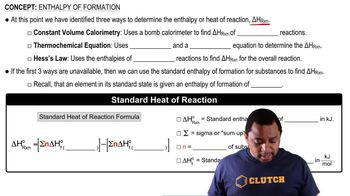
Enthalpy (∆H)

Enthalpy is a measure of the total heat content of a system. In an isothermal process, such as the compression of an ideal gas at constant temperature, the internal energy remains constant, and any work done on the gas is balanced by heat exchange with the surroundings. For this process, ∆H is 0, indicating no net heat transfer into or out of the system.
Video consigliato:
Percorso guidato
02:34
Enthalpy of Formation

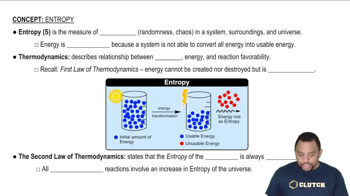
Entropy (∆S)

Entropy is a measure of the disorder or randomness in a system. When an ideal gas is compressed, the number of available microstates decreases, leading to a reduction in disorder. Therefore, for this isothermal compression, ∆S is negative, reflecting a decrease in the system's entropy as the gas molecules are forced closer together.
Video consigliato:
Percorso guidato
02:46
Entropy in Thermodynamics

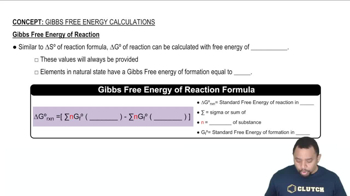
Gibbs Free Energy (∆G)

Gibbs Free Energy combines enthalpy and entropy to determine the spontaneity of a process. The relationship is given by the equation ∆G = ∆H - T∆S. Since ∆H is 0 and ∆S is negative, ∆G will be positive, indicating that the process is non-spontaneous under constant temperature conditions. This means that work must be done on the system to achieve the compression.
Video consigliato:
Percorso guidato
01:51
Gibbs Free Energy of Reactions
Pratica correlata
Domanda del libro di testo

Consider the dissociation reaction A2(g) ⇌ 2 A(g). The following pictures represent two possible initial states and the equilibrium state of the system:

(b) What are the signs ( + , - , or 0) of ∆H, ∆S, and ∆G when the system goes from initial state 1 to the equilibrium state? Explain. Is this a spontaneous process?

275
views
Domanda del libro di testo
Rank the situations represented by the following drawings according to increasing entropy.
326
views
Domanda del libro di testo
The following pictures represent equilibrium mixtures for the interconversion of A molecules (red) and X, Y, or Z molecules (blue):

What is the sign of ∆G° for each of the three reactions?
381
views
Domanda del libro di testo

Ideal gases A (red spheres) and B (blue spheres) occupy two separate bulbs. The contents of both bulbs constitute the initial state of an isolated system. Consider the process that occurs when the stopcock is opened.

(c) How dpes this process illustrate the second law of thermodynamics?

326
views
Domanda del libro di testo
Consider again the dissociation reaction

(e) What is the value of ∆G for the dissociation reaction when the system is at equilibrium?
312
views
Domanda del libro di testo

Ideal gases A (red spheres) and B (blue spheres) occupy two separate bulbs. The contents of both bulbs constitute the initial state of an isolated system. Consider the process that occurs when the stopcock is opened.

(d) Relate each of the pictures to the graph in Figure 18.11.

327
views