Ch.18 - Thermodynamics: Entropy, Free Energy & Equilibrium
McMurry - Chemistry 8th Edition
McMurry8th EditionChemistryISBN: 9781292336145Non è quello che usi tu?Cambia libro di testo
Capitolo 18, Problema 85b

Consider a twofold expansion of 1 mol of an ideal gas at 25 °C in the isolated system shown in Figure 18.1. (b) How does this process illustrate the second law of thermodynamics?

Guida verificata passo dopo passo
1
Identify the initial state of the system: The system initially contains 1 mol of an ideal gas at 25 °C. Since the system is isolated, no heat or matter can be exchanged with the surroundings.
Understand the process of expansion: The gas undergoes a twofold expansion, meaning the volume of the gas doubles. This is typically a reversible or irreversible adiabatic process where no heat is transferred to or from the gas.
Apply the first law of thermodynamics: For an isolated system, the change in internal energy (ΔU) is zero because there is no heat exchange (Q = 0) and no work done by the surroundings (W = 0). Thus, ΔU = Q + W = 0.
Relate to the second law of thermodynamics: The second law states that in any spontaneous process, the entropy of the universe increases. In this case, the entropy of the gas increases as it expands into a larger volume, allowing more microstates and thus higher entropy.
Conclude how the process illustrates the second law: The twofold expansion of the gas without heat exchange in an isolated system shows an increase in entropy, aligning with the second law of thermodynamics which predicts that entropy should increase in a spontaneous process.

Risposta video verificata per un problema simile:

Questa soluzione video è stata consigliata dai nostri tutor come utile per risolvere questo problema.
Durata del video:
4m

Concetti chiave

Ecco i concetti essenziali che devi comprendere per rispondere correttamente alla domanda.

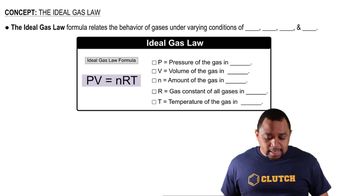
Ideal Gas Law

The Ideal Gas Law describes the relationship between pressure, volume, temperature, and the number of moles of an ideal gas, expressed as PV = nRT. This law is fundamental in understanding gas behavior under various conditions, particularly in thermodynamic processes. In the context of the question, it helps analyze how the gas expands and the changes in its state variables.
Video consigliato:
Percorso guidato
01:15
Ideal Gas Law Formula

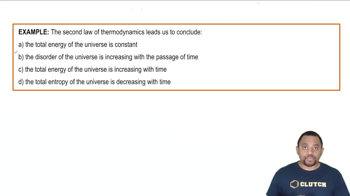
Second Law of Thermodynamics

The Second Law of Thermodynamics states that the total entropy of an isolated system can never decrease over time. It implies that natural processes tend to move towards a state of maximum disorder or randomness. In the case of the gas expansion, the increase in volume leads to an increase in entropy, illustrating this principle as the system evolves towards a more disordered state.
Video consigliato:
Percorso guidato
00:48
Second Law of Thermodynamics Example

Isolated System

An isolated system is one that does not exchange matter or energy with its surroundings. In thermodynamics, this concept is crucial for analyzing processes without external influences. The gas expansion in an isolated system allows for the examination of internal changes, such as energy distribution and entropy, without the complications of heat or work interactions with the environment.
Video consigliato:
Percorso guidato
02:06
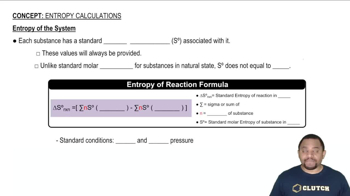
Entropy of the System