
Ch.18 - Thermodynamics: Entropy, Free Energy & Equilibrium
McMurry - Chemistry 8th Edition
McMurry8th EditionChemistryISBN: 9781292336145Non è quello che usi tu?Cambia libro di testo
Capitolo 18, Problema 105

Consider the conversion of 1,2-dichloroethane to vinyl chloride, the starting material for manufacturing poly(vinyl chloride) (PVC) plastics: Is this reaction spontaneous under standard-state conditions? Would it help to carry out the reaction in the presence of base to remove HCl? Explain. Is it possible to synthesize vinyl chlo-ride from graphite, gaseous H2, and gaseous Cl2 at 25 °C and 1 atm pressure?

Guida verificata passo dopo passo
1
Identify the reaction: The conversion of 1,2-dichloroethane to vinyl chloride involves the elimination of HCl. The reaction can be represented as: \[ \text{C}_2\text{H}_4\text{Cl}_2 \rightarrow \text{C}_2\text{H}_3\text{Cl} + \text{HCl} \]
Determine spontaneity: To assess if the reaction is spontaneous under standard-state conditions, calculate the Gibbs free energy change (\( \Delta G^\circ \)). Use the equation \( \Delta G^\circ = \Delta H^\circ - T\Delta S^\circ \), where \( \Delta H^\circ \) is the enthalpy change and \( \Delta S^\circ \) is the entropy change.
Consider the effect of a base: Adding a base can help remove HCl as it forms, shifting the equilibrium towards the products according to Le Chatelier's principle. This can make the reaction more favorable.
Synthesize from graphite, H2, and Cl2: To synthesize vinyl chloride from graphite, gaseous H2, and Cl2, consider the overall reaction: \[ \text{C(graphite)} + \text{H}_2\text{(g)} + \text{Cl}_2\text{(g)} \rightarrow \text{C}_2\text{H}_3\text{Cl} \]. Calculate the \( \Delta G^\circ \) for this reaction to determine feasibility.
Evaluate conditions: Ensure that the conditions (25 °C and 1 atm) are suitable for the reaction. Consider the thermodynamic data for each component to assess the feasibility of the synthesis under these conditions.

Risposta video verificata per un problema simile:

Questa soluzione video è stata consigliata dai nostri tutor come utile per risolvere questo problema.
Durata del video:
9m

Concetti chiave

Ecco i concetti essenziali che devi comprendere per rispondere correttamente alla domanda.

Spontaneity of Reactions

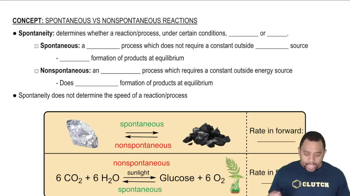
The spontaneity of a chemical reaction is determined by the change in Gibbs free energy (ΔG). A reaction is spontaneous under standard-state conditions if ΔG is negative, indicating that the products are more stable than the reactants. Factors such as enthalpy (ΔH) and entropy (ΔS) changes during the reaction also influence ΔG, as described by the equation ΔG = ΔH - TΔS.
Video consigliato:
Percorso guidato
04:20
Spontaneity of Processes

Role of Bases in Reactions

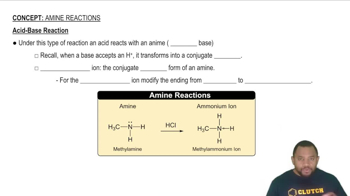
In organic reactions, bases can facilitate the removal of acidic byproducts, such as HCl in this case, which can shift the equilibrium towards product formation. By removing HCl, the reaction may proceed more favorably, potentially increasing the yield of vinyl chloride. This principle is often applied in reactions where the formation of a stable product is hindered by the presence of acidic species.
Video consigliato:
Percorso guidato
01:32
Acid-Base Reaction

Synthesis from Basic Reactants

The synthesis of vinyl chloride from graphite, H2, and Cl2 involves understanding the reactivity of these substances under specific conditions. At 25 °C and 1 atm, the reaction would require appropriate activation energy and conditions to proceed. The feasibility of this synthesis depends on the thermodynamics and kinetics of the reaction, including the formation of intermediates and the stability of the final product.
Video consigliato:
Percorso guidato
08:25
Balancing Basic Redox Reaction Example