Ch.18 - Thermodynamics: Entropy, Free Energy & Equilibrium
McMurry - Chemistry 8th Edition
McMurry8th EditionChemistryISBN: 9781292336145Non è quello che usi tu?Cambia libro di testo
Capitolo 18, Problema 77a

Phosphorus pentachloride forms from phosphorus trichloride and chlorine:
(a) Use data in Appendix B to calculate ∆Ssys, ∆Ssurr, and ∆Stotal for this reaction. Is the reaction spontaneous under standard-state conditions at 25 °C?

Guida verificata passo dopo passo
1
1. First, we need to write down the balanced chemical equation for the reaction. The reaction is: PCl3(g) + Cl2(g) -> PCl5(g).
2. Next, we need to calculate the change in entropy (∆S) for the system (∆Ssys). This can be done by subtracting the sum of the standard molar entropies of the reactants from the sum of the standard molar entropies of the products. The standard molar entropies can be found in Appendix B. The formula is: ∆Ssys = ∑S°products - ∑S°reactants.
3. To calculate the change in entropy for the surroundings (∆Ssurr), we need to use the formula: ∆Ssurr = -∆Hsys/T, where ∆Hsys is the change in enthalpy for the system and T is the absolute temperature in Kelvin. The standard enthalpy change for the reaction can be found in Appendix B and the temperature is given as 25 °C, which is 298.15 K.
4. The total entropy change (∆Stotal) is the sum of ∆Ssys and ∆Ssurr. So, ∆Stotal = ∆Ssys + ∆Ssurr.
5. Finally, to determine if the reaction is spontaneous under standard-state conditions at 25 °C, we need to check the sign of ∆Stotal. If ∆Stotal is positive, the reaction is spontaneous. If ∆Stotal is negative, the reaction is non-spontaneous.

Risposta video verificata per un problema simile:

Questa soluzione video è stata consigliata dai nostri tutor come utile per risolvere questo problema.
Durata del video:
7m

Concetti chiave

Ecco i concetti essenziali che devi comprendere per rispondere correttamente alla domanda.

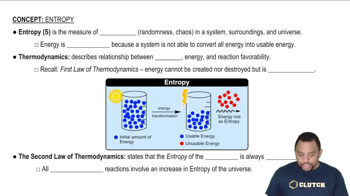
Entropy (∆S)

Entropy is a measure of the disorder or randomness in a system. In thermodynamics, the change in entropy (∆S) can indicate the spontaneity of a reaction; a positive ∆S suggests an increase in disorder, which often favors spontaneity. Calculating ∆S for a reaction involves considering the entropy of the products and reactants, and it is crucial for determining the overall behavior of the system.
Video consigliato:
Percorso guidato
02:46
Entropy in Thermodynamics

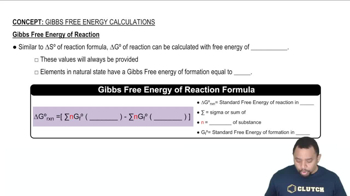
Gibbs Free Energy (∆G)

Gibbs Free Energy (∆G) is a thermodynamic potential that helps predict whether a reaction will occur spontaneously at constant temperature and pressure. The relationship between Gibbs Free Energy and entropy is given by the equation ∆G = ∆H - T∆S, where ∆H is the change in enthalpy and T is the temperature in Kelvin. A negative ∆G indicates that a reaction is spontaneous, making it essential for evaluating the spontaneity of the given reaction.
Video consigliato:
Percorso guidato
01:51
Gibbs Free Energy of Reactions

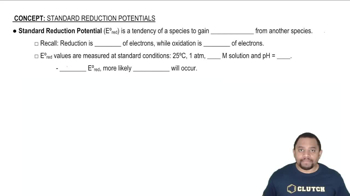
Standard-State Conditions

Standard-state conditions refer to a set of specific conditions used to measure and compare thermodynamic properties, typically defined as 1 bar of pressure and a specified temperature, usually 25 °C. Under these conditions, the standard entropies and enthalpies of substances can be found in tables, allowing for consistent calculations of thermodynamic changes in reactions. Understanding these conditions is vital for accurately assessing the spontaneity of the reaction in question.
Video consigliato:
Percorso guidato
01:10
Standard Reduction Potentials