Ch.18 - Thermodynamics: Entropy, Free Energy & Equilibrium
McMurry - Chemistry 8th Edition
McMurry8th EditionChemistryISBN: 9781292336145Non è quello che usi tu?Cambia libro di testo
Capitolo 18, Problema 111

Urea (NH2CONH2), an important nitrogen fertilizer, is produced industrially by the reaction Given that ∆G° = -13.6 kJ, calculate ∆G at 25 °C for the following sets of conditions. . (a) 10 atm NH3, 10 atm CO2, 1.0 M NH2CONH2 (b) 0.10 atm NH3, 0.10 atm CO2, 1.0 M NH2CONH2 Is the reaction spontaneous for the conditions in part (a) and/or part (b)?

Guida verificata passo dopo passo
1
Identify the reaction: NH3(g) + CO2(g) ⇌ NH2CONH2(aq).
Use the equation for Gibbs free energy change: \( \Delta G = \Delta G^\circ + RT \ln Q \), where \( R \) is the gas constant (8.314 J/mol·K) and \( T \) is the temperature in Kelvin.
Calculate the reaction quotient \( Q \) for each set of conditions. For gases, use partial pressures, and for aqueous solutions, use concentrations. \( Q = \frac{[NH2CONH2]}{P_{NH3} \times P_{CO2}} \).
Convert the temperature from Celsius to Kelvin: \( T = 25 + 273.15 = 298.15 \text{ K} \).
Substitute \( \Delta G^\circ \), \( R \), \( T \), and \( Q \) into the Gibbs free energy equation to find \( \Delta G \) for each condition. Determine spontaneity: if \( \Delta G < 0 \), the reaction is spontaneous.

Risposta video verificata per un problema simile:

Questa soluzione video è stata consigliata dai nostri tutor come utile per risolvere questo problema.
Durata del video:
5m

Concetti chiave

Ecco i concetti essenziali che devi comprendere per rispondere correttamente alla domanda.

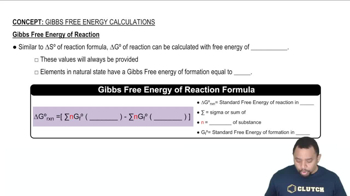
Gibbs Free Energy (∆G)

Gibbs Free Energy (∆G) is a thermodynamic potential that measures the maximum reversible work obtainable from a thermodynamic system at constant temperature and pressure. It is a crucial indicator of spontaneity; a negative ∆G indicates that a reaction can occur spontaneously, while a positive ∆G suggests non-spontaneity. The standard Gibbs free energy change (∆G°) provides a baseline for calculating ∆G under non-standard conditions using the reaction quotient.
Video consigliato:
Percorso guidato
01:51
Gibbs Free Energy of Reactions

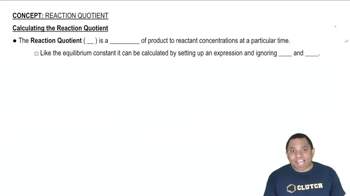
Reaction Quotient (Q)

The reaction quotient (Q) is a dimensionless number that reflects the ratio of the concentrations of products to reactants at any point in a reaction, raised to the power of their stoichiometric coefficients. It is used to determine the direction in which a reaction will proceed to reach equilibrium. By comparing Q to the equilibrium constant (K), one can assess whether the reaction is spontaneous under given conditions, as spontaneity is influenced by the relative concentrations of reactants and products.
Video consigliato:
Percorso guidato
00:49
Reaction Quotient Q

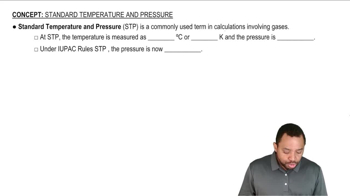
Temperature and Pressure Effects on Reactions

Temperature and pressure significantly influence chemical reactions, particularly in gaseous systems. Changes in temperature can affect the kinetic energy of molecules, thereby altering reaction rates and equilibria. For reactions involving gases, pressure changes can shift the position of equilibrium according to Le Chatelier's principle, impacting the Gibbs free energy and spontaneity of the reaction. Understanding these effects is essential for predicting the behavior of reactions under varying conditions.
Video consigliato:
Percorso guidato
01:08
Standard Temperature and Pressure