Ch.19 - Electrochemistry
McMurry - Chemistry 8th Edition
McMurry8th EditionChemistryISBN: 9781292336145Non è quello che usi tu?Cambia libro di testo
Capitolo 19, Problema 97

A galvanic cell has an iron electrode in contact with 0.10 M FeSO4 and a copper electrode in contact with a CuSO4 solu-tion. If the measured cell potential at 25 °C is 0.67 V, what is the concentration of Cu2+ in the CuSO4 solution?

Guida verificata passo dopo passo
1
Identify the half-reactions for the galvanic cell: Fe(s) \(\rightarrow\) Fe^{2+}(aq) + 2e^- and Cu^{2+}(aq) + 2e^- \(\rightarrow\) Cu(s).
Write the overall cell reaction by combining the half-reactions: Fe(s) + Cu^{2+}(aq) \(\rightarrow\) Fe^{2+}(aq) + Cu(s).
Use the Nernst equation to relate the cell potential to the concentrations: E_{cell} = E^\(\circ\)_{cell} - \(\frac{RT}{nF}\) \(\ln\) Q, where Q is the reaction quotient.
Calculate the standard cell potential, E^\(\circ\)_{cell}, using standard reduction potentials: E^\(\circ\)_{cell} = E^\(\circ\)_{Cu^{2+}/Cu} - E^\(\circ\)_{Fe^{2+}/Fe}.
Solve for the concentration of Cu^{2+} using the Nernst equation and the given cell potential, 0.67 V, by substituting known values and solving for the unknown concentration.

Risposta video verificata per un problema simile:

Questa soluzione video è stata consigliata dai nostri tutor come utile per risolvere questo problema.
Durata del video:
4m

Concetti chiave

Ecco i concetti essenziali che devi comprendere per rispondere correttamente alla domanda.

Galvanic Cell

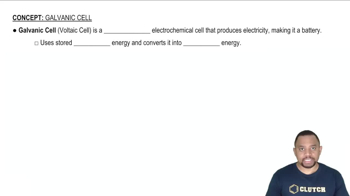
A galvanic cell is an electrochemical cell that converts chemical energy into electrical energy through spontaneous redox reactions. It consists of two electrodes, an anode and a cathode, immersed in electrolyte solutions. The flow of electrons from the anode to the cathode generates an electric current, and the cell potential is determined by the difference in reduction potentials of the two half-reactions.
Video consigliato:
Percorso guidato
01:08
The Galvanic Cell

Nernst Equation

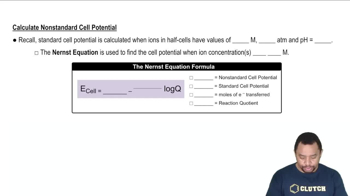
The Nernst equation relates the cell potential to the concentrations of the reactants and products in an electrochemical reaction. It is expressed as E = E° - (RT/nF) ln(Q), where E° is the standard cell potential, R is the gas constant, T is the temperature in Kelvin, n is the number of moles of electrons transferred, F is Faraday's constant, and Q is the reaction quotient. This equation allows for the calculation of cell potential under non-standard conditions.
Video consigliato:
Percorso guidato
01:17
The Nernst Equation

Reaction Quotient (Q)

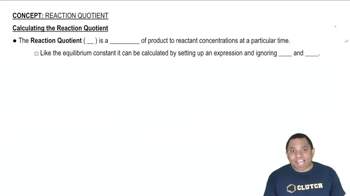
The reaction quotient (Q) is a measure of the relative concentrations of reactants and products in a chemical reaction at a given moment. It is calculated using the formula Q = [products]/[reactants], where the concentrations are raised to the power of their coefficients in the balanced equation. In the context of a galvanic cell, Q helps determine the direction of the reaction and the cell potential, especially when concentrations deviate from standard conditions.
Video consigliato:
Percorso guidato
00:49
Reaction Quotient Q
Pratica correlata
Domanda del libro di testo
Consider a galvanic cell that uses the reaction Calculate the potential at 25 °C for a cell that has the following ion concentrations: [Ag+] = 0.010M, [Ni2+] = 0.100M.
1227
views

Domanda del libro di testo
Given the following half-reactions and E° values, write a balanced equation for the formation of Mn2+ and MnO2 from Mn3+, and calculate the value of E° for this reaction. Is the reaction spontaneous under standard-state conditions?
1214
views
Domanda del libro di testo
The Nernst equation applies to both cell reactions and half-reactions. For the conditions specified, calculate the potential for the following half-reactions at 25 °C. (b)
1298
views
1
rank
Domanda del libro di testo

Consider a galvanic cell that uses the following half-reactions: (b) What is the oxidizing agent, and what is the reducing agent?.

872
views
Domanda del libro di testo
What is the Fe2+: Sn2+ concentration ratio in the following cell at 25 °C if the measured cell potential is 0.35 V?
612
views
Domanda del libro di testo

When suspected drunk drivers are tested with a Breathalyzer, the alcohol (ethanol) in the exhaled breath is oxidized to acetic acid with an acidic solution of potassium dichromate: The color of the solution changes because some of the orange Cr2O72- is converted to the green Cr3+ The Breathalyzer measures the color change and produces a meter reading calibrated in blood alcohol content. (a) What is E° for the reaction if the standard half-cell potential for the reduction of acetic acid to ethanol is 0.058 V?

801
views