Ch.19 - Electrochemistry
McMurry - Chemistry 8th Edition
McMurry8th EditionChemistryISBN: 9781292336145Non è quello che usi tu?Cambia libro di testo
Capitolo 19, Problema 62a

An H2/H+ half-cell (anode) and an Ag+/Ag half cell (cathode) are connected by a wire and a salt bridge. (a) Sketch the cell, indicating the direction of electron and ion flow.

Guida verificata passo dopo passo
1
Start by drawing two separate containers or beakers to represent the half-cells. Label one as the H2/H+ half-cell (anode) and the other as the Ag+/Ag half-cell (cathode).
In the anode half-cell, draw a platinum electrode immersed in a solution containing H+ ions. Above the solution, indicate the presence of H2 gas.
In the cathode half-cell, draw a silver electrode immersed in a solution containing Ag+ ions.
Connect the two electrodes with a wire, and indicate the direction of electron flow from the anode to the cathode.
Draw a salt bridge connecting the two solutions, and indicate the flow of ions: anions moving towards the anode and cations moving towards the cathode.

Risposta video verificata per un problema simile:

Questa soluzione video è stata consigliata dai nostri tutor come utile per risolvere questo problema.
Durata del video:
4m

Concetti chiave

Ecco i concetti essenziali che devi comprendere per rispondere correttamente alla domanda.

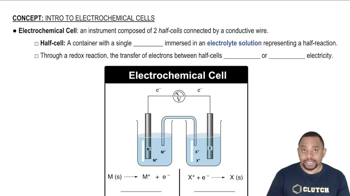
Electrochemical Cells

Electrochemical cells consist of two half-cells, where oxidation occurs at the anode and reduction at the cathode. In this setup, the H2/H+ half-cell serves as the anode, where hydrogen gas is oxidized to protons, while the Ag+/Ag half-cell acts as the cathode, where silver ions are reduced to solid silver. Understanding the flow of electrons and ions is crucial for analyzing the cell's operation.
Video consigliato:
Percorso guidato
02:46
Electrochemical Cells

Electron Flow

In an electrochemical cell, electrons flow from the anode to the cathode through an external circuit. This flow occurs because oxidation at the anode generates electrons, which are then attracted to the cathode, where reduction takes place. Recognizing the direction of electron flow is essential for understanding how the cell generates electrical energy.
Video consigliato:
Percorso guidato
04:44
Electron Geometry

Salt Bridge Function

A salt bridge is a crucial component of an electrochemical cell that maintains electrical neutrality by allowing the flow of ions between the two half-cells. It typically contains a gel or solution of an inert electrolyte, which helps balance the charge as electrons move through the external circuit. Understanding the role of the salt bridge is important for ensuring the continuous operation of the cell.
Video consigliato: