Beginning with the equations that relate E°, ∆G°, and K, show that ∆G° is negative and K 7 1 for a reaction that has a positive value of E°
Guida verificata passo dopo passo
1
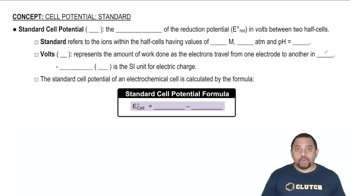
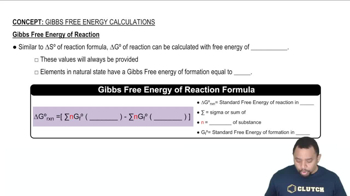
Start by recalling the relationship between the standard cell potential (E°), the standard Gibbs free energy change (∆G°), and the equilibrium constant (K). The equation is: ∆G° = -nFE°, where n is the number of moles of electrons transferred in the reaction and F is the Faraday constant.
Understand that if E° is positive, then -nFE° will be negative, indicating that ∆G° is negative. This implies that the reaction is spontaneous under standard conditions.
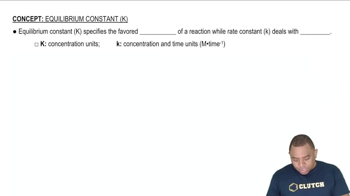
Next, consider the relationship between ∆G° and the equilibrium constant K, given by the equation: ∆G° = -RT ln K, where R is the universal gas constant and T is the temperature in Kelvin.
Since ∆G° is negative when E° is positive, substitute this into the equation: -RT ln K < 0. This implies that ln K > 0.
Finally, if ln K > 0, then K > 1. This shows that for a reaction with a positive E°, ∆G° is negative and K is greater than 1, indicating a spontaneous reaction with a tendency to favor the formation of products.
Risposta video verificata per un problema simile:
Questa soluzione video è stata consigliata dai nostri tutor come utile per risolvere questo problema.
Durata del video:
3m
Guarda un video:
0 Commenti
Concetti chiave
Ecco i concetti essenziali che devi comprendere per rispondere correttamente alla domanda.
Gibbs Free Energy (∆G°)
Gibbs Free Energy (∆G°) is a thermodynamic potential that measures the maximum reversible work obtainable from a thermodynamic process at constant temperature and pressure. A negative value of ∆G° indicates that a reaction is spontaneous, meaning it can occur without external energy input. This concept is crucial for understanding the favorability of chemical reactions.
Standard Electrode Potential (E°) is a measure of the tendency of a chemical species to be reduced, expressed in volts. A positive E° value suggests that the reaction is favorable and can drive the formation of products. The relationship between E° and ∆G° is given by the equation ∆G° = -nFE°, where n is the number of moles of electrons transferred and F is Faraday's constant.
The equilibrium constant (K) quantifies the ratio of the concentrations of products to reactants at equilibrium for a given reaction. A K value greater than 1 indicates that products are favored at equilibrium, aligning with a spontaneous reaction. The relationship between K and ∆G° is expressed by the equation ∆G° = -RT ln(K), where R is the gas constant and T is the temperature in Kelvin.


 Guida verificata passo dopo passo
 01:51
01:51