Ch.19 - Electrochemistry
McMurry - Chemistry 8th Edition
McMurry8th EditionChemistryISBN: 9781292336145Non è quello che usi tu?Cambia libro di testo
Capitolo 19, Problema 91

Calculate E° for each of the following reactions, and tell which are spontaneous under standard-state conditions. (a)

Guida verificata passo dopo passo
1
insert step 1
insert step 2
insert step 3
insert step 4
insert step 5

Risposta video verificata per un problema simile:

Questa soluzione video è stata consigliata dai nostri tutor come utile per risolvere questo problema.
Durata del video:
3m

Concetti chiave

Ecco i concetti essenziali che devi comprendere per rispondere correttamente alla domanda.

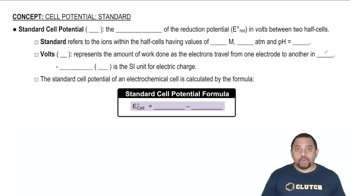
Standard Electrode Potential (E°)

Standard electrode potential (E°) is a measure of the tendency of a chemical species to be reduced, measured under standard conditions (1 M concentration, 1 atm pressure, and 25°C). It is expressed in volts and is crucial for predicting the direction of redox reactions. A positive E° indicates a spontaneous reaction, while a negative E° suggests non-spontaneity.
Video consigliato:
Percorso guidato
01:27
Standard Cell Potential

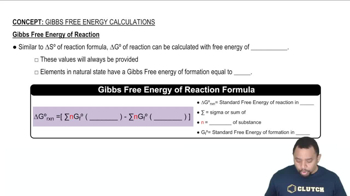
Gibbs Free Energy (ΔG)

Gibbs free energy (ΔG) is a thermodynamic potential that indicates the spontaneity of a reaction at constant temperature and pressure. The relationship between E° and ΔG is given by the equation ΔG = -nFE°, where n is the number of moles of electrons transferred and F is Faraday's constant. A negative ΔG corresponds to a spontaneous reaction.
Video consigliato:
Percorso guidato
01:51
Gibbs Free Energy of Reactions

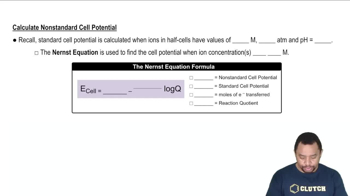
Nernst Equation

The Nernst equation relates the cell potential (E) of an electrochemical reaction to the standard electrode potential (E°) and the concentrations of the reactants and products. It is expressed as E = E° - (RT/nF)ln(Q), where Q is the reaction quotient. This equation allows for the calculation of E under non-standard conditions and helps determine the spontaneity of reactions based on concentration changes.
Video consigliato:
Percorso guidato
01:17
The Nernst Equation