Ch.19 - Electrochemistry
McMurry - Chemistry 8th Edition
McMurry8th EditionChemistryISBN: 9781292336145Non è quello che usi tu?Cambia libro di testo
Capitolo 19, Problema 56

Describe galvanic cells that use the following reactions. In each case, write the anode and cathode half-reactions and sketch the experimental setup. Label the anode and cathode, identify the sign of each electrode, and indicate the direction of electron and ion flow. (b)

Guida verificata passo dopo passo
1
Identify the overall chemical reaction for the galvanic cell. This will help you determine the half-reactions that occur at the anode and cathode.
Write the oxidation half-reaction. This occurs at the anode, where electrons are lost. Identify the species being oxidized and write the balanced half-reaction.
Write the reduction half-reaction. This occurs at the cathode, where electrons are gained. Identify the species being reduced and write the balanced half-reaction.
Sketch the experimental setup of the galvanic cell. Label the anode and cathode, and indicate the direction of electron flow from the anode to the cathode through the external circuit.
Label the salt bridge and indicate the direction of ion flow. Cations move towards the cathode, and anions move towards the anode to maintain charge balance.

Risposta video verificata per un problema simile:

Questa soluzione video è stata consigliata dai nostri tutor come utile per risolvere questo problema.
Durata del video:
2m

Concetti chiave

Ecco i concetti essenziali che devi comprendere per rispondere correttamente alla domanda.

Galvanic Cells

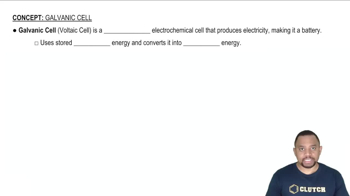
Galvanic cells, also known as voltaic cells, are electrochemical cells that convert chemical energy into electrical energy through spontaneous redox reactions. They consist of two half-cells, each containing an electrode immersed in an electrolyte. The anode is where oxidation occurs, releasing electrons, while the cathode is where reduction takes place, accepting electrons. This flow of electrons generates an electric current, which can be harnessed for external work.
Video consigliato:
Percorso guidato
01:08
The Galvanic Cell

Half-Reactions

Half-reactions are the individual oxidation and reduction reactions that occur in an electrochemical cell. Each half-reaction shows the transfer of electrons and the change in oxidation states of the reactants. In a galvanic cell, the anode half-reaction involves the loss of electrons (oxidation), while the cathode half-reaction involves the gain of electrons (reduction). Understanding these half-reactions is crucial for identifying the overall cell reaction and determining the flow of electrons.
Video consigliato:
Percorso guidato
01:49
First-Order Half-Life

Electrode Sign and Ion Flow

In a galvanic cell, the anode is designated as negative and the cathode as positive due to the flow of electrons from the anode to the cathode. This flow of electrons is accompanied by the movement of ions in the electrolyte; cations migrate towards the cathode, while anions move towards the anode. This ion flow is essential for maintaining charge balance within the cell and allows the redox reactions to continue. Properly labeling the electrodes and understanding the direction of flow is vital for analyzing the cell's operation.
Video consigliato: