
Ch.19 - Electrochemistry
McMurry - Chemistry 8th Edition
McMurry8th EditionChemistryISBN: 9781292336145Non è quello che usi tu?Cambia libro di testo
Capitolo 19, Problema 163

Gold metal is extracted from its ore by treating the crushed rock with an aerated cyanide solution. The unbalanced equation for the reaction is (b) Use any of the following data at 25 °C to calculate ∆G° for this reaction at 25 °C: Kf for Au(CN)2- = 6.2 x 10^38, Ka for HCN = 4.9 x 10^-10, and standard reduction potentials are

Guida verificata passo dopo passo
1
Identify the balanced chemical equation for the extraction of gold using cyanide. The general form involves gold (Au), cyanide ions (CN^-), and oxygen (O2) to form the complex ion Au(CN)2^-.
Use the given formation constant (Kf) for Au(CN)2^- to find the standard Gibbs free energy change (∆G°) for the formation of the complex ion. The relationship is given by ∆G° = -RT ln(Kf), where R is the universal gas constant and T is the temperature in Kelvin.
Consider the dissociation of HCN in water, which is represented by its acid dissociation constant (Ka). Use the relationship ∆G° = -RT ln(Ka) to find the Gibbs free energy change for the dissociation of HCN.
Use the standard reduction potentials to calculate the standard Gibbs free energy change for the redox reactions involved. The relationship between standard reduction potential (E°) and Gibbs free energy is ∆G° = -nFE°, where n is the number of moles of electrons transferred and F is Faraday's constant.
Combine the Gibbs free energy changes from the formation of the complex ion, the dissociation of HCN, and the redox reactions to find the overall ∆G° for the extraction process. This involves summing the individual ∆G° values calculated in the previous steps.

Risposta video verificata per un problema simile:

Questa soluzione video è stata consigliata dai nostri tutor come utile per risolvere questo problema.
Durata del video:
11m

Concetti chiave

Ecco i concetti essenziali che devi comprendere per rispondere correttamente alla domanda.

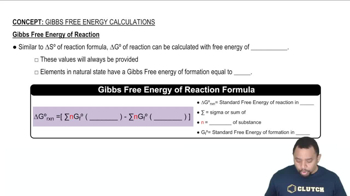
Gibbs Free Energy (∆G°)

Gibbs Free Energy (∆G°) is a thermodynamic potential that measures the maximum reversible work obtainable from a thermodynamic process at constant temperature and pressure. It indicates the spontaneity of a reaction; a negative ∆G° suggests that the reaction can occur spontaneously, while a positive value indicates non-spontaneity. Understanding how to calculate ∆G° using equilibrium constants or standard reduction potentials is crucial for predicting reaction behavior.
Video consigliato:
Percorso guidato
01:51
Gibbs Free Energy of Reactions

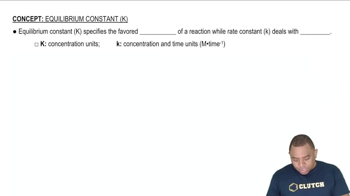
Equilibrium Constant (K)

The equilibrium constant (K) quantifies the ratio of the concentrations of products to reactants at equilibrium for a given reaction at a specific temperature. For reactions involving complex ions, such as Au(CN)2-, the formation constant (Kf) is particularly important, as it reflects the stability of the complex in solution. The relationship between K and ∆G° is given by the equation ∆G° = -RT ln(K), linking thermodynamics and chemical equilibrium.
Video consigliato:
Percorso guidato
01:14
Equilibrium Constant K

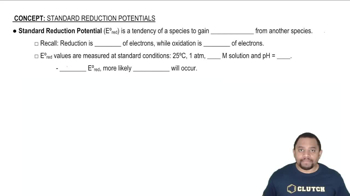
Standard Reduction Potentials

Standard reduction potentials (E°) are measures of the tendency of a chemical species to gain electrons and be reduced, expressed in volts. Each half-reaction has a specific E° value, and the overall cell potential can be calculated by combining these values. This concept is essential for understanding redox reactions and calculating ∆G° using the equation ∆G° = -nFE°, where n is the number of moles of electrons transferred and F is Faraday's constant.
Video consigliato:
Percorso guidato
01:10
Standard Reduction Potentials
Pratica correlata
Domanda del libro di testo

The half-reactions that occur in ordinary alkaline batteries can be written as In 1999, researchers in Israel reported a new type of alkaline battery, called a 'super-iron' battery. This battery uses the same anode reaction as an ordinary alkaline battery but involves the reduction of FeO42- ion (from K2FeO4) to solid Fe(OH)3 at the cathode. (a) Use the following standard reduction potential and any data from Appendixes C and D to calculate the standard cell potential expected for an ordinary alkaline battery:

798
views
Domanda del libro di testo

We've said that the +1 oxidation state is uncommon for indium but is the most stable state for thallium. Verify this statement by calculating E ° and ΔG ° (in kilojoules) for the disproportionation reaction

3 M+1aq2S M3+1aq2 + 2 M1s2 M = In or Tl

Is disproportionation a spontaneous reaction for In+ and/orTl+? Standard reduction potentials for the relevant halfreactions are

In3+1aq2 + 2 e- S In+1aq2 E° = -0.44 V

In+1aq2 + e- S In1s2 E° = -0.14 V

Tl3+1aq2 + 2 e- S Tl+1aq2 E° = +1.25 V

Tl+1aq2 + e- S Tl1s2 E° = -0.34 V

201
views
Domanda del libro di testo

The half-reactions that occur in ordinary alkaline batteries can be written as In 1999, researchers in Israel reported a new type of alkaline battery, called a 'super-iron' battery. This battery uses the same anode reaction as an ordinary alkaline battery but involves the reduction of FeO42- ion (from K2FeO4) to solid Fe(OH)3 at the cathode. (b) Write a balanced equation for the cathode half-reaction in a super-iron battery. The half-reaction occurs in a basic environment.

486
views
Domanda del libro di testo

The half-reactions that occur in ordinary alkaline batteries can be written as In 1999, researchers in Israel reported a new type of alkaline battery, called a 'super-iron' battery. This battery uses the same anode reaction as an ordinary alkaline battery but involves the reduction of FeO42- ion (from K2FeO4) to solid Fe(OH)3 at the cathode. (c) A super-iron battery should last longer than an ordinary alkaline battery of the same size and weight because its cathode can provide more charge per unit mass. Quan-titatively compare the number of coulombs of charge released by the reduction of 10.0 g K2FeO4 to Fe(OH)3 with the number of coulombs of charge released by the reduction 10.0 g of MnO2 to MnO(OH).

311
views
Domanda del libro di testo
Consider the redox titration of 100.0 mL of a solution of 0.010 M Fe2+ in 1.50 M H2SO4 with a 0.010 M solution of KMnO4, yielding Fe3+ and Mn2+. The titration is carried out in an electrochemical cell equipped with a platinum electrode and a calomel reference electrode consisting of an Hg2Cl2/Hg electrode in contract with a saturated KCl solution having [Cl-] = 2.9M. Using any data in Appendixes C and D, calculate the cell potential after addition of (a) 5.0 mL, (b) 10.0mL, (c) 19.0 mL, and (d) 21.0 mL of the KMnO4 solution.
435
views