Ch.19 - Electrochemistry
McMurry - Chemistry 8th Edition
McMurry8th EditionChemistryISBN: 9781292336145Non è quello che usi tu?Cambia libro di testo
Capitolo 19, Problema 140

How many hours are required to produce 1.00 * 103 kg of sodium by the electrolysis of molten NaCl with a constant current of 3.00 * 104 A? How many liters of Cl2 at STP will be obtained as a by-product?

Guida verificata passo dopo passo
1
Identify the chemical reaction involved in the electrolysis of molten NaCl: \(2\text{NaCl} \rightarrow 2\text{Na} + \text{Cl}_2\).
Calculate the moles of sodium (Na) to be produced using its molar mass: \(\text{moles of Na} = \frac{\text{mass of Na}}{\text{molar mass of Na}}\).
Determine the moles of electrons required using the stoichiometry of the reaction: 2 moles of electrons are needed to produce 2 moles of Na.
Use Faraday's law of electrolysis to find the total charge required: \(Q = n \times F\), where \(n\) is the moles of electrons and \(F\) is Faraday's constant (96485 C/mol).
Calculate the time in seconds using the formula \(t = \frac{Q}{I}\), where \(I\) is the current, and then convert the time from seconds to hours.

Risposta video verificata per un problema simile:

Questa soluzione video è stata consigliata dai nostri tutor come utile per risolvere questo problema.
Durata del video:
6m

Concetti chiave

Ecco i concetti essenziali che devi comprendere per rispondere correttamente alla domanda.

Electrolysis

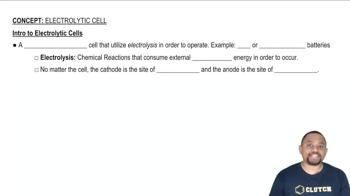
Electrolysis is a chemical process that uses electrical energy to drive a non-spontaneous reaction. In the case of molten NaCl, electrolysis separates sodium ions (Na+) and chloride ions (Cl-) at the anode and cathode, respectively. This process is essential for producing sodium metal and chlorine gas from sodium chloride.
Video consigliato:
Percorso guidato
01:21
The Electrolytic Cell

Faraday's Laws of Electrolysis

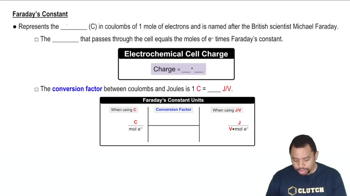
Faraday's Laws of Electrolysis quantify the relationship between the amount of substance produced at an electrode and the electric charge passed through the electrolyte. The first law states that the mass of a substance produced is directly proportional to the electric charge. This principle is crucial for calculating the time required for electrolysis based on current and the amount of sodium desired.
Video consigliato:
Percorso guidato
01:40
Faraday's Constant in Electrochemistry

Stoichiometry of Gases

Stoichiometry of gases involves the relationships between the volumes of gases and the amounts of substances in a chemical reaction, particularly under standard temperature and pressure (STP). At STP, one mole of any gas occupies 22.4 liters. This concept is vital for determining the volume of chlorine gas produced as a by-product during the electrolysis of NaCl.
Video consigliato:
Percorso guidato
01:16
Stoichiometry Concept
Pratica correlata
Domanda del libro di testo

Predict the anode, cathode, and overall cell reactions when an aqueous solution of each of the following salts is electrolyzed in a cell having inert electrodes. (c) LiOH

455
views

Domanda del libro di testo
Predict the anode, cathode, and overall cell reactions when an aqueous solution of each of the following salts is electrolyzed in a cell having inert electrodes. (a) Ag2SO4
1277
views
Domanda del libro di testo

Predict the anode, cathode, and overall cell reactions when an aqueous solution of each of the following salts is electrolyzed in a cell having inert electrodes. (b) CuCl2

692
views
Domanda del libro di testo
Electrolysis of a metal nitrate solution M(NO3)2(aq) for 325 min with a constant current of 20.0 A gives 111 g of the metal. Identify the metal ion M2+.
837
views
Domanda del libro di testo
What constant current (in amperes) is required to produce aluminum by the Hall–Héroult process at a rate of 40.0 kg/h?
424
views
Domanda del libro di testo
Aluminum, titanium, and several other metals can be col-ored by an electrochemical process called anodizing. Anodizing oxidizes a metal anode to yield a porous metal oxide coating that can incorporate dye molecules to give brilliant colors. In the oxidation of aluminum, for instance, the electrode reactions are The thickness of the aluminum oxide coating that forms on the anode can be controlled by varying the current flow during the electrolysis. How many minutes are required to produce a 0.0100-mm thick coating of Al2O3 (density 3.97 g/cm^3) on a square piece of aluminum metal 10.0 cm on an edge if the current passed through the piece is 0.600 A?
768
views