The following cell reactions occur spontaneously: (a) Arrange the following reduction half-reactions in order of decreasing tendency to occur:
Ch.19 - Electrochemistry
Capitolo 19, Problema 79b
The following cell reactions occur spontaneously: (b) Which of these substances (A,A+,B,B+,C,C+) is the strongest oxidizing agent? Which is the strongest reducing agent?
Guida verificata passo dopo passo1
Step 1: Understand the terms 'oxidizing agent' and 'reducing agent'. An oxidizing agent is a substance that gains electrons and is reduced in a chemical reaction, while a reducing agent is a substance that loses electrons and is oxidized.
Step 2: Identify the half-reactions for each of the given substances (A, A+, B, B+, C, C+). Determine which species are being reduced and which are being oxidized.
Step 3: Use the standard reduction potential table to find the reduction potentials for each half-reaction. The substance with the highest reduction potential is the strongest oxidizing agent.
Step 4: Conversely, the substance with the lowest reduction potential (or highest oxidation potential) is the strongest reducing agent.
Step 5: Compare the reduction potentials of the given substances to determine which is the strongest oxidizing agent and which is the strongest reducing agent.

Risposta video verificata per un problema simile:
Questa soluzione video è stata consigliata dai nostri tutor come utile per risolvere questo problema.
Durata del video:
3mConcetti chiave
Ecco i concetti essenziali che devi comprendere per rispondere correttamente alla domanda.
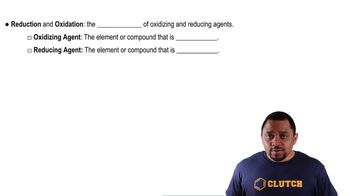
Oxidizing and Reducing Agents
An oxidizing agent is a substance that gains electrons in a chemical reaction, causing another substance to be oxidized. Conversely, a reducing agent loses electrons, leading to the reduction of another substance. The strength of these agents is determined by their ability to accept or donate electrons, respectively.
Video consigliato:
Percorso guidato
Oxidizing and Reducing Agents
Electrode Potentials
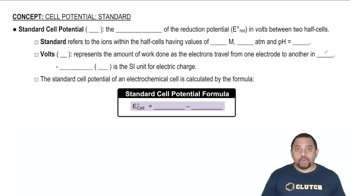
Electrode potentials, measured in volts, indicate the tendency of a species to be reduced. A higher (more positive) electrode potential signifies a stronger oxidizing agent, while a lower (more negative) potential indicates a stronger reducing agent. These values are essential for predicting the direction of redox reactions.
Video consigliato:
Percorso guidato
Standard Cell Potential
Spontaneity of Reactions
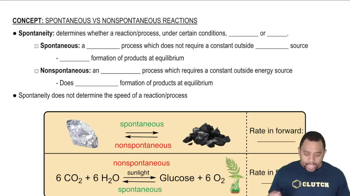
A spontaneous reaction occurs without external intervention, often driven by changes in energy or entropy. In redox reactions, spontaneity can be assessed using the Gibbs free energy change, which is related to the electrode potentials of the oxidizing and reducing agents involved.
Video consigliato:
Percorso guidato
Spontaneity of Processes
Pratica correlata
Domanda del libro di testo
370
views
Domanda del libro di testo
The following cell reactions occur spontaneously:
(c) Which of the three cell reactions delivers the highest voltage?
315
views
Domanda del libro di testo
Use the data in Appendix D to predict whether the following reactions can occur under standard-state conditions. (b) Reduction of Ni2+(aq) by Sn2+(aq)
299
views
Domanda del libro di testo
Consider the following substances: Fe(s), PbO2(s), H+(aq), Al(s), Ag(s), Cr2O72-(aq). (a) Look at the E° values in Appendix D, and classify each substance as an oxidizing agent or a reducing agent.
448
views
Domanda del libro di testo
Use the data in Appendix D to predict whether the following reactions can occur under standard-state conditions. (c) Oxidation of Ag(s) by Pb2+(aq)
341
views
Domanda del libro di testo
Use the data in Appendix D to predict whether the following reactions can occur under standard-state conditions. (a) Oxidation of Sn2+(aq) by Br2(aq)
541
views
1
rank