Ch.19 - Electrochemistry
McMurry - Chemistry 8th Edition
McMurry8th EditionChemistryISBN: 9781292336145Non è quello che usi tu?Cambia libro di testo
Capitolo 19, Problema 116

The following galvanic cell has a potential of 1.214 V at 25 °C: Calculate the value of Ksp for Hg2Br2 at 25°C

Guida verificata passo dopo passo
1
Identify the half-reactions involved in the galvanic cell. For Hg2Br2, the relevant half-reaction is: Hg2Br2(s) + 2e^- → 2Hg(l) + 2Br^-(aq).
Determine the standard reduction potentials (E°) for the half-reactions. Use a table of standard reduction potentials to find the E° values for the half-reactions involved.
Use the Nernst equation to relate the cell potential (E) to the standard cell potential (E°) and the reaction quotient (Q): E = E° - (RT/nF) * ln(Q).
Since the cell potential is given at standard conditions (25 °C), you can use the simplified form of the Nernst equation: E = E° - (0.0592/n) * log(Q).
Solve for the solubility product constant (Ksp) using the relationship between Q and Ksp for the dissolution of Hg2Br2: Ksp = [Hg^2+]^2[Br^-]^2.

Risposta video verificata per un problema simile:

Questa soluzione video è stata consigliata dai nostri tutor come utile per risolvere questo problema.
Durata del video:
17m

Concetti chiave

Ecco i concetti essenziali che devi comprendere per rispondere correttamente alla domanda.

Galvanic Cells

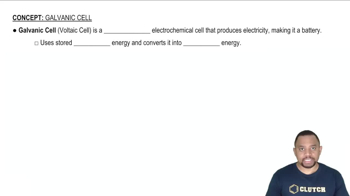
Galvanic cells, also known as voltaic cells, are electrochemical cells that convert chemical energy into electrical energy through spontaneous redox reactions. They consist of two half-cells, each containing an electrode and an electrolyte. The flow of electrons from the anode to the cathode generates an electric current, and the cell potential (voltage) is determined by the difference in reduction potentials of the two half-reactions.
Video consigliato:
Percorso guidato
01:08
The Galvanic Cell

Nernst Equation

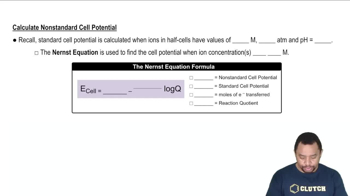
The Nernst equation relates the cell potential of an electrochemical cell to the concentrations of the reactants and products involved in the redox reactions. It is expressed as E = E° - (RT/nF) ln(Q), where E is the cell potential, E° is the standard cell potential, R is the universal gas constant, T is the temperature in Kelvin, n is the number of moles of electrons transferred, F is Faraday's constant, and Q is the reaction quotient. This equation is essential for calculating equilibrium constants like Ksp from cell potentials.
Video consigliato:
Percorso guidato
01:17
The Nernst Equation

Solubility Product Constant (Ksp)

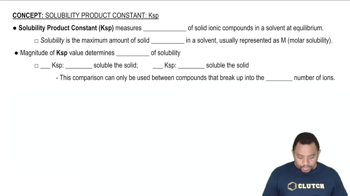
The solubility product constant (Ksp) is an equilibrium constant that quantifies the solubility of a sparingly soluble ionic compound in water. It is defined as the product of the molar concentrations of the ions, each raised to the power of their coefficients in the balanced dissolution equation. For Hg2Br2, Ksp can be calculated using the concentrations of Hg2^2+ and Br^- ions at equilibrium, which can be derived from the cell potential using the Nernst equation.
Video consigliato:
Percorso guidato
01:47
Solubility Product Constant