
The reaction of MnO4– with oxalic acid (H2C2O4) in acidic solution, yielding Mn2+ and CO2 gas, is widely used to determine the concentration of permanganate solutions. (a) Write a balanced net ionic equation for the reaction.
Ch.19 - Electrochemistry
Capitolo 19, Problema 155b,c
The reaction of MnO4– with oxalic acid (H2C2O4) in acidic solution, yielding Mn2+ and CO2 gas, is widely used to determine the concentration of permanganate solutions. (b) Use the data in Appendix D to calculate E° for the reaction. (c) Show that the reaction goes to completion by calculating the values of ∆G° and K at 25 °C. (H2C2O4) in acidic solution, yielding Mn2+ and CO2 gas, is widely used to determine the concentration of permanganate solutions.
Guida verificata passo dopo passo1
Identify the half-reactions involved in the redox process. For the given reaction, the reduction half-reaction is MnO4– + 8H+ + 5e– → Mn2+ + 4H2O, and the oxidation half-reaction is H2C2O4 → 2CO2 + 2H+ + 2e–.
Use the standard reduction potentials from Appendix D to find the E° values for each half-reaction. The standard reduction potential for MnO4– to Mn2+ is typically given, and you will need to reverse the sign for the oxidation of H2C2O4 to CO2.
Calculate the standard cell potential, E°, for the overall reaction by combining the half-reactions. Use the formula E° = E°(cathode) - E°(anode). Ensure that the number of electrons lost in the oxidation half-reaction equals the number gained in the reduction half-reaction by multiplying the half-reactions by appropriate coefficients.
Calculate the standard Gibbs free energy change, ΔG°, using the formula ΔG° = -nFE°, where n is the number of moles of electrons transferred in the balanced equation, F is the Faraday constant (approximately 96485 C/mol), and E° is the standard cell potential.
Determine the equilibrium constant, K, at 25 °C using the relationship between ΔG° and K: ΔG° = -RT ln K, where R is the universal gas constant (8.314 J/mol·K) and T is the temperature in Kelvin. Solve for K to show that the reaction goes to completion.

Risposta video verificata per un problema simile:
Questa soluzione video è stata consigliata dai nostri tutor come utile per risolvere questo problema.
Durata del video:
13mConcetti chiave
Ecco i concetti essenziali che devi comprendere per rispondere correttamente alla domanda.
Standard Electrode Potential (E°)
The standard electrode potential (E°) is a measure of the tendency of a chemical species to be reduced, measured under standard conditions. It is crucial for predicting the direction of redox reactions and calculating the overall cell potential. In this context, E° values for the half-reactions involving MnO4– and oxalic acid will help determine the feasibility of the reaction.
Video consigliato:
Percorso guidato
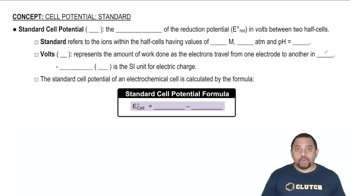
Standard Cell Potential
Gibbs Free Energy (∆G°)
Gibbs Free Energy (∆G°) is a thermodynamic quantity that indicates the spontaneity of a reaction at standard conditions. A negative ∆G° value suggests that a reaction is spontaneous and will proceed to completion. In this case, calculating ∆G° for the reaction will provide insight into whether the reaction between MnO4– and oxalic acid is thermodynamically favorable.
Video consigliato:
Percorso guidato
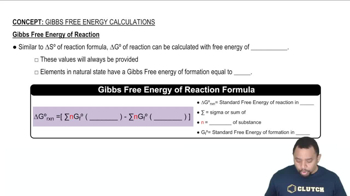
Gibbs Free Energy of Reactions
Equilibrium Constant (K)
The equilibrium constant (K) quantifies the ratio of the concentrations of products to reactants at equilibrium for a given reaction. It is related to Gibbs Free Energy by the equation ∆G° = -RT ln(K). A large K value indicates that products are favored at equilibrium, which, when calculated for the reaction, will confirm whether it goes to completion.
Video consigliato:
Percorso guidato
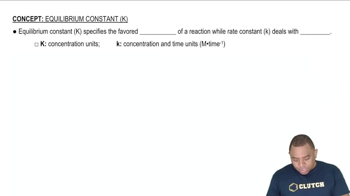
Equilibrium Constant K
Pratica correlata
Domanda del libro di testo
853
views
Domanda del libro di testo
Given the following standard reduction potentials at 25 °C, (a) balance the equation for the reaction of H2MoO4 with elemental arsenic in acidic solution to give Mo3+ and H3AsO4 and (b) calculate E° for this reaction.
721
views
Domanda del libro di testo
The reaction of MnO4– with oxalic acid (H2C2O4) in acidic solution, yielding Mn2+ and CO2 gas, is widely used to determine the concentration of permanganate solutions. (d) A 1.200 g sample of sodium oxalate (Na2C2O4) is dissolved in dilute H2SO4 and then titrated with a KMnO4 solution. If 32.50 mL of the KMnO4 solution is required to reach the equivalence point, what is the molarity of the KMnO4 solution?
1607
views
Domanda del libro di testo
A concentration cell has the same half-reactions at the anode and cathode, but a voltage results from different concentrations in the two electrode compartments.
(b) A similar cell has 0.10 M Cu2+ in both compartments. When a stoichiometric amount of ethylenediamine (NH2CH2CH2NH2) is added to one compartment, the measured cell potential is 0.179 V. Calculate the formation constant Kf for the complex ion Cu(NH2CH2CH2CH2)22+. Assume there is no volume change.
796
views
