Ch.19 - Electrochemistry
McMurry - Chemistry 8th Edition
McMurry8th EditionChemistryISBN: 9781292336145Non è quello che usi tu?Cambia libro di testo
Capitolo 19, Problema 83a

What reaction can occur, if any, when the following experiments are carried out under standard-state conditions? (a) A strip of zinc is dipped into an aqueous solution of Pb(NO3)2.

Guida verificata passo dopo passo
1
Identify the reactants involved in the experiment: zinc metal (Zn) and lead(II) nitrate (Pb(NO3)2).
Write down the possible half-reactions for each reactant. For zinc, it can oxidize, losing electrons: Zn(s) → Zn^2+(aq) + 2e^-. For lead(II) nitrate, the lead(II) ions can reduce, gaining electrons: Pb^2+(aq) + 2e^- → Pb(s).
Consult the standard reduction potential table to find the values for each half-reaction. The standard reduction potential for the zinc reaction (as an oxidation) is -0.76 V and for the lead reaction (as a reduction) is -0.13 V.
Compare the reduction potentials to determine the feasibility of the reaction. The substance with the higher (less negative) reduction potential will undergo reduction, while the other will undergo oxidation.
Conclude that since the reduction potential of lead(II) is higher than that of zinc, lead(II) ions will be reduced to lead metal, and zinc metal will be oxidized to zinc ions. Thus, a redox reaction will occur where zinc displaces lead from its nitrate solution.

Risposta video verificata per un problema simile:

Questa soluzione video è stata consigliata dai nostri tutor come utile per risolvere questo problema.
Durata del video:
2m

Concetti chiave

Ecco i concetti essenziali che devi comprendere per rispondere correttamente alla domanda.

Redox Reactions

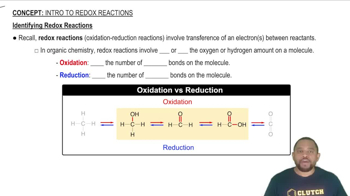
Redox reactions involve the transfer of electrons between substances, leading to changes in oxidation states. In the context of the question, zinc (Zn) can act as a reducing agent, losing electrons, while lead ions (Pb^2+) can gain electrons, thus being reduced. Understanding the principles of oxidation and reduction is essential for predicting the outcome of the reaction.
Video consigliato:
Percorso guidato
03:12
Identifying Redox Reactions

Standard-State Conditions

Standard-state conditions refer to a set of specific conditions (1 atm pressure, 25°C temperature, and 1 M concentration for solutions) under which the properties of substances are measured. These conditions provide a consistent framework for comparing thermodynamic data and predicting the feasibility of reactions, such as the one between zinc and lead nitrate.
Video consigliato:
Percorso guidato
01:10
Standard Reduction Potentials

Activity Series of Metals

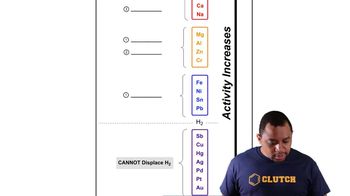
The activity series is a list of metals ranked by their ability to displace other metals from solutions of their ions. Zinc is more reactive than lead, meaning it can displace lead ions from the solution. This concept is crucial for determining whether a reaction will occur when zinc is placed in a solution of Pb(NO3)2.
Video consigliato:
Percorso guidato
02:02
Activity Series Chart