Ch.19 - Electrochemistry
McMurry - Chemistry 8th Edition
McMurry8th EditionChemistryISBN: 9781292336145Non è quello che usi tu?Cambia libro di testo
Capitolo 19, Problema 46a

Write unbalanced oxidation and reduction half-reactions for the following processes. . (a) Te(s) + NO3-(aq) → TeO2(s) + NO(g)

Guida verificata passo dopo passo
1
Identify the oxidation and reduction processes by determining the change in oxidation states of the elements involved.
For the oxidation half-reaction, note that Te(s) is oxidized to TeO_2(s). Determine the change in oxidation state for Te.
Write the unbalanced oxidation half-reaction: Te(s) → TeO_2(s).
For the reduction half-reaction, note that NO_3^-(aq) is reduced to NO(g). Determine the change in oxidation state for N.
Write the unbalanced reduction half-reaction: NO_3^-(aq) → NO(g).

Risposta video verificata per un problema simile:

Questa soluzione video è stata consigliata dai nostri tutor come utile per risolvere questo problema.
Durata del video:
5m

Concetti chiave

Ecco i concetti essenziali che devi comprendere per rispondere correttamente alla domanda.

Oxidation and Reduction

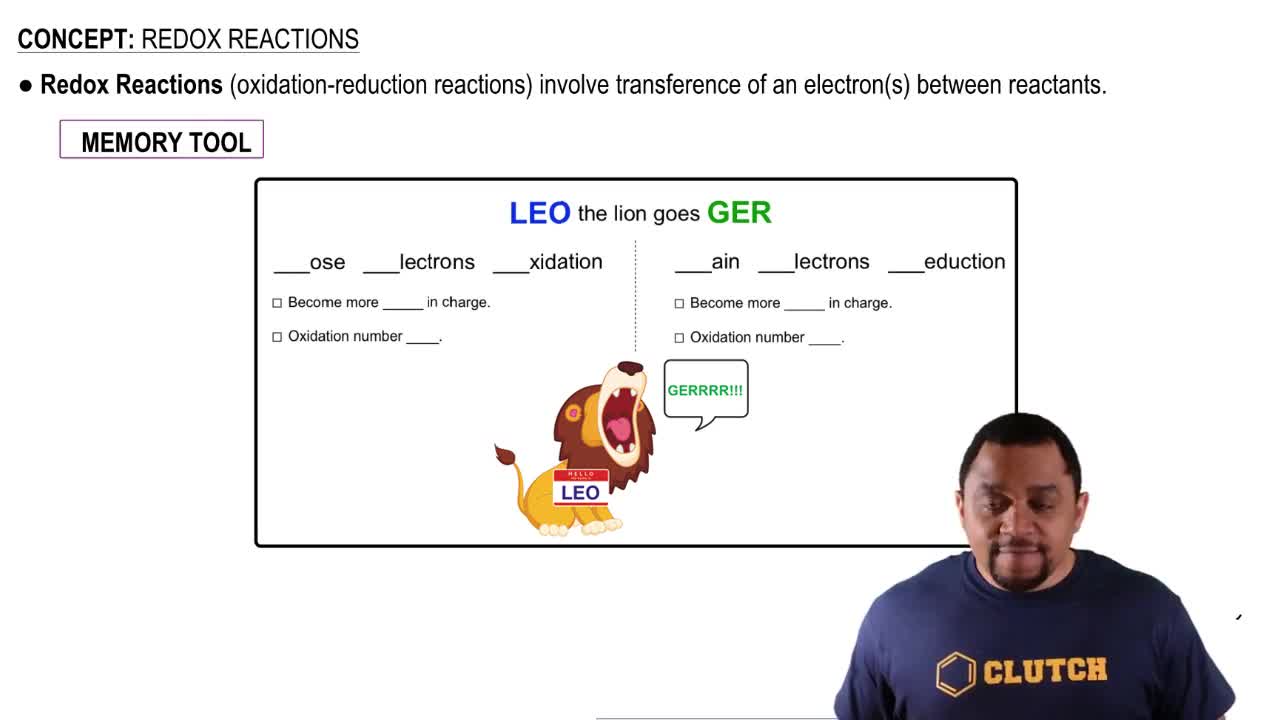
Oxidation and reduction are chemical processes that involve the transfer of electrons between species. Oxidation refers to the loss of electrons, resulting in an increase in oxidation state, while reduction involves the gain of electrons, leading to a decrease in oxidation state. In redox reactions, one species is oxidized and another is reduced, which is essential for balancing half-reactions.
Video consigliato:
Percorso guidato
01:53
Oxidation and Reduction Reactions

Half-Reactions

Half-reactions are used to represent the oxidation and reduction processes separately in a redox reaction. Each half-reaction shows either the loss of electrons (oxidation) or the gain of electrons (reduction) and allows for easier balancing of the overall reaction. By writing half-reactions, one can clearly identify the changes in oxidation states and the electrons involved.
Video consigliato:
Percorso guidato
01:49
First-Order Half-Life

Balancing Redox Reactions

Balancing redox reactions involves ensuring that the number of atoms and the charge are equal on both sides of the equation. This can be achieved using the half-reaction method, where each half-reaction is balanced for mass and charge before combining them. It is crucial to account for electrons, protons, and any other species involved to achieve a balanced overall reaction.
Video consigliato:
Percorso guidato
01:04
Balancing Basic Redox Reactions