Ch.2 - Atoms, Molecules & Ions
McMurry - Chemistry 8th Edition
McMurry8th EditionChemistryISBN: 9781292336145Non è quello che usi tu?Cambia libro di testo
Capitolo 2, Problema 113b

(b) The mole is a unit used to represent a very large number of atoms. How many atoms are equivalent to 1 mol of atoms?

Guida verificata passo dopo passo
1
Understand that a mole (mol) is a basic unit in chemistry used to express amounts of a chemical substance.
Recognize that Avogadro's number is the number of units (atoms, molecules, ions, etc.) in one mole of any substance.
Identify Avogadro's number, which is approximately \(6.022 \times 10^{23}\) units per mole.
Apply Avogadro's number to determine the number of atoms in one mole of any element.
Conclude that 1 mole of atoms contains \(6.022 \times 10^{23}\) atoms.

Risposta video verificata per un problema simile:

Questa soluzione video è stata consigliata dai nostri tutor come utile per risolvere questo problema.
Durata del video:
2m

Concetti chiave

Ecco i concetti essenziali che devi comprendere per rispondere correttamente alla domanda.

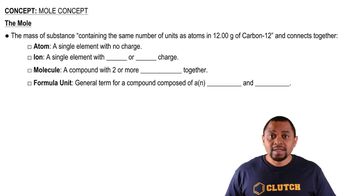
Mole Concept

The mole is a fundamental unit in chemistry that quantifies the amount of substance. It is defined as containing exactly 6.022 x 10^23 entities, which can be atoms, molecules, or ions. This number, known as Avogadro's number, allows chemists to convert between the mass of a substance and the number of particles it contains.
Video consigliato:

Avogadro's Number

Avogadro's number (6.022 x 10^23) is a constant that represents the number of atoms, molecules, or particles in one mole of a substance. This concept is crucial for stoichiometry, as it provides a bridge between the macroscopic scale of substances we can measure and the microscopic scale of atoms and molecules.
Video consigliato:

Stoichiometry

Stoichiometry is the area of chemistry that deals with the relationships between the quantities of reactants and products in chemical reactions. It relies on the mole concept and Avogadro's number to calculate how much of each substance is involved in a reaction, allowing chemists to predict the outcomes of reactions based on the amounts of reactants used.
Video consigliato:
Percorso guidato
01:16
Stoichiometry Concept