Ch.2 - Atoms, Molecules & Ions
McMurry - Chemistry 8th Edition
McMurry8th EditionChemistryISBN: 9781292336145Non è quello che usi tu?Cambia libro di testo
Capitolo 2, Problema 37b

Classify these elements as metals, nonmetals, or semimetals.

Guida verificata passo dopo passo
1
Step 1: Identify the elements in the problem.
Step 2: Refer to the periodic table to locate each element.
Step 3: Determine the classification of each element based on its position in the periodic table.
Step 4: Metals are typically found on the left side and center of the periodic table, nonmetals on the right side, and semimetals (metalloids) are located along the zig-zag line dividing metals and nonmetals.
Step 5: Classify each element as a metal, nonmetal, or semimetal based on its position and properties.

Risposta video verificata per un problema simile:

Questa soluzione video è stata consigliata dai nostri tutor come utile per risolvere questo problema.
Durata del video:
2m

Concetti chiave

Ecco i concetti essenziali che devi comprendere per rispondere correttamente alla domanda.

Metals

Metals are elements that typically exhibit high electrical and thermal conductivity, malleability, ductility, and a shiny appearance. They are usually solid at room temperature (except mercury) and tend to lose electrons during chemical reactions, forming positive ions. Common examples include iron, copper, and aluminum.
Video consigliato:
Percorso guidato
03:12
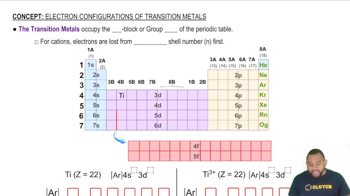
Transition Metals

Nonmetals

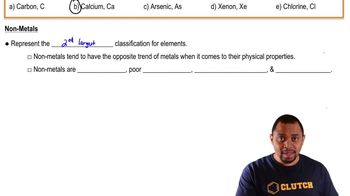
Nonmetals are elements that generally lack the properties of metals and are characterized by poor conductivity, brittleness in solid form, and a variety of physical states (solid, liquid, gas) at room temperature. They tend to gain electrons in chemical reactions, forming negative ions. Examples include oxygen, nitrogen, and sulfur.
Video consigliato:
Percorso guidato
01:12
Nonmetal Properties

Semimetals (Metalloids)

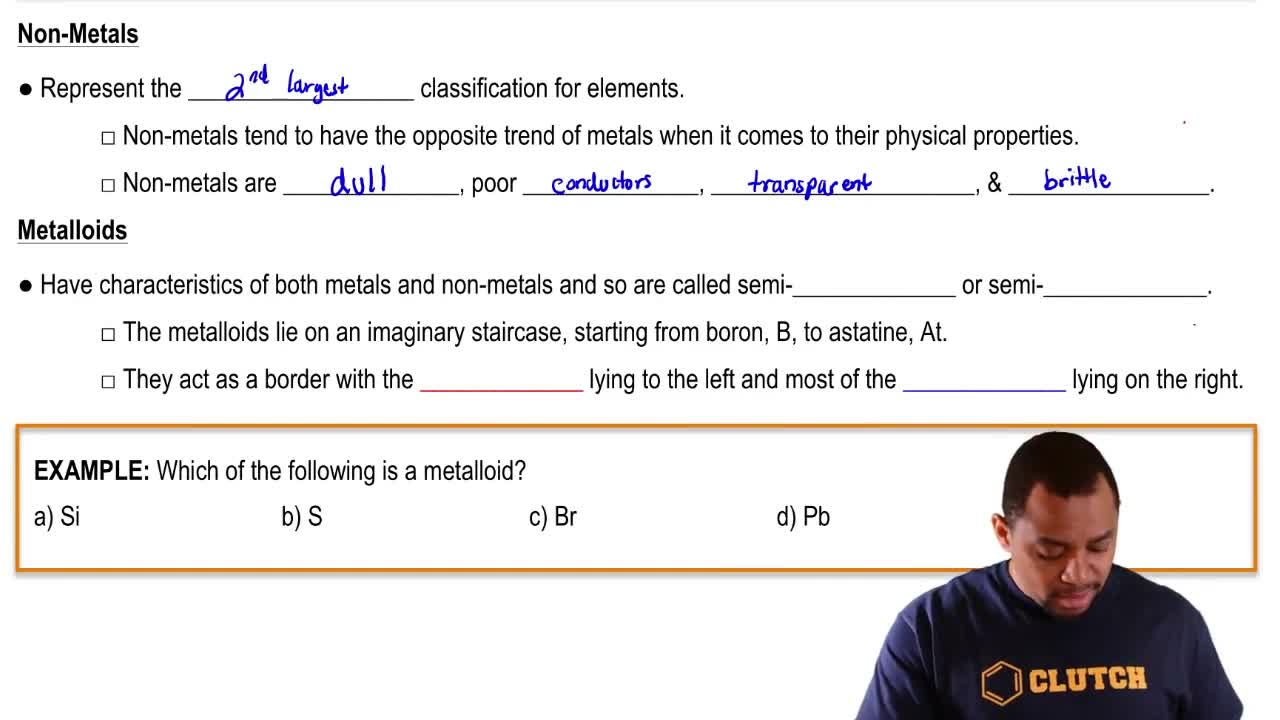
Semimetals, or metalloids, are elements that possess properties intermediate between metals and nonmetals. They are typically semiconductors of electricity, making them valuable in electronics. Common semimetals include silicon, germanium, and arsenic, which can exhibit metallic luster but are brittle and can behave as either metals or nonmetals in chemical reactions.
Video consigliato:
Percorso guidato
03:37
Metalloid Properties