Ch.2 - Atoms, Molecules & Ions
McMurry - Chemistry 8th Edition
McMurry8th EditionChemistryISBN: 9781292336145Non è quello che usi tu?Cambia libro di testo
Capitolo 2, Problema 104d

How many protons, neutrons, and electrons are in each of the following atoms? (d)

Guida verificata passo dopo passo
1
Step 1: Identify the atomic number (Z) and the atomic mass number (A) of the atom. The atomic number is the number of protons in the nucleus of an atom, and it is unique to each element. The atomic mass number is the total number of protons and neutrons in the nucleus.
Step 2: Determine the number of protons in the atom. The number of protons is equal to the atomic number (Z).
Step 3: Determine the number of neutrons in the atom. The number of neutrons is equal to the atomic mass number (A) minus the atomic number (Z).
Step 4: Determine the number of electrons in the atom. In a neutral atom, the number of electrons is equal to the number of protons. If the atom is an ion, the number of electrons will be the number of protons plus or minus the charge of the ion.
Step 5: Summarize your findings. State the number of protons, neutrons, and electrons in the atom.

Risposta video verificata per un problema simile:

Questa soluzione video è stata consigliata dai nostri tutor come utile per risolvere questo problema.
Durata del video:
2m

Concetti chiave

Ecco i concetti essenziali che devi comprendere per rispondere correttamente alla domanda.

Atomic Structure

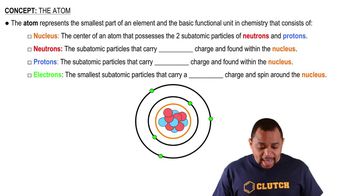
Atoms are the basic units of matter, consisting of protons, neutrons, and electrons. Protons are positively charged particles found in the nucleus, neutrons are neutral particles also located in the nucleus, and electrons are negatively charged particles that orbit the nucleus. The number of protons defines the element, while the total number of protons and neutrons gives the atomic mass.
Video consigliato:

Atomic Number and Mass Number

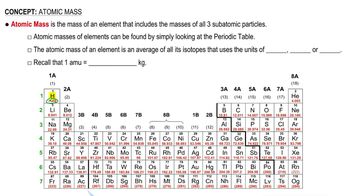
The atomic number of an element is the number of protons in its nucleus, which determines the element's identity. The mass number is the sum of protons and neutrons in the nucleus. For example, an atom with 6 protons and 6 neutrons has an atomic number of 6 (carbon) and a mass number of 12.
Video consigliato:

Charge Balance in Atoms

In a neutral atom, the number of electrons equals the number of protons, balancing the overall charge. If an atom gains or loses electrons, it becomes an ion, which can be positively charged (cation) or negatively charged (anion). Understanding this balance is crucial for determining the electron count in various atomic species.
Video consigliato: