Ch.2 - Atoms, Molecules & Ions
McMurry - Chemistry 8th Edition
McMurry8th EditionChemistryISBN: 9781292336145Non è quello che usi tu?Cambia libro di testo
Capitolo 2, Problema 106

Identify the following elements: (a)

Guida verificata passo dopo passo
1
Step 1: Understand the context of the problem. It seems like the problem is asking to identify elements based on some given information, which is missing here.
Step 2: Typically, to identify an element, you might be given information such as atomic number, atomic mass, or a description of its properties.
Step 3: If you have the atomic number, you can use the periodic table to find the element. The atomic number corresponds to the number of protons in an atom of the element.
Step 4: If you have the atomic mass, you can look for the element with a similar atomic mass on the periodic table. Keep in mind that isotopes can affect the atomic mass.
Step 5: If you have a description of properties, such as 'a noble gas' or 'a metal that reacts with water,' use your knowledge of periodic trends and element groups to identify the element.

Risposta video verificata per un problema simile:

Questa soluzione video è stata consigliata dai nostri tutor come utile per risolvere questo problema.
Durata del video:
2m

Concetti chiave

Ecco i concetti essenziali che devi comprendere per rispondere correttamente alla domanda.

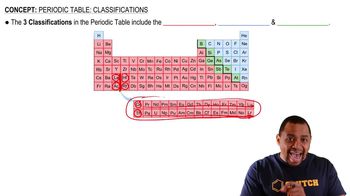
Periodic Table

The periodic table organizes all known chemical elements based on their atomic number, electron configuration, and recurring chemical properties. Elements are arranged in rows (periods) and columns (groups), which helps predict their behavior in reactions. Understanding the layout of the periodic table is essential for identifying elements and their relationships.
Video consigliato:
Percorso guidato
02:40
Periodic Table Classifications

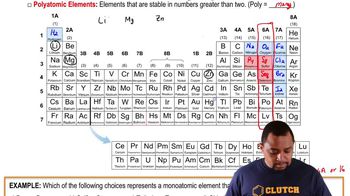
Element Identification

Element identification involves recognizing elements based on their symbols, atomic numbers, and properties. Each element has a unique atomic number that corresponds to the number of protons in its nucleus. Familiarity with common elements and their symbols is crucial for accurately identifying them in chemical equations and reactions.
Video consigliato:
Percorso guidato
01:15
Chalcogen Identification Example

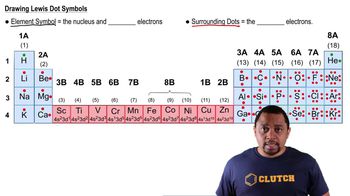
Chemical Symbols

Chemical symbols are one- or two-letter abbreviations used to represent elements in chemical formulas and equations. For example, 'H' stands for hydrogen and 'O' for oxygen. Understanding these symbols is vital for interpreting chemical reactions and communicating information about substances in chemistry.
Video consigliato:
Percorso guidato
03:17
Lewis Dot Symbols