
Ch.2 - Atoms, Molecules & Ions
McMurry - Chemistry 8th Edition
McMurry8th EditionChemistryISBN: 9781292336145Non è quello che usi tu?Cambia libro di testo
Capitolo 2, Problema 2

Identify the location of the element in period 4, group 6A and classify it as a metal, nonmetal, or semimetal. (LO 2.2) (a) Element in position a; nonmetal (b) Element in position b; metal (c) Element in position c; semimetal (d) Element in position d; metal

Guida verificata passo dopo passo
1
Identify the periodic table's structure, where periods are horizontal rows and groups are vertical columns.
Locate period 4 on the periodic table, which includes elements from potassium (K) to krypton (Kr).
Find group 6A (or group 16 in the IUPAC numbering system), which includes elements like oxygen (O), sulfur (S), and selenium (Se).
Determine the element in period 4, group 6A, which is selenium (Se).
Classify selenium (Se) as a nonmetal based on its properties and position in the periodic table.

Risposta video verificata per un problema simile:

Questa soluzione video è stata consigliata dai nostri tutor come utile per risolvere questo problema.
Durata del video:
1m

Concetti chiave

Ecco i concetti essenziali che devi comprendere per rispondere correttamente alla domanda.

Periodic Table Organization

The periodic table is organized into periods (rows) and groups (columns) that categorize elements based on their atomic structure and properties. Elements in the same group often exhibit similar chemical behaviors, while those in the same period have the same number of electron shells. Understanding this organization is crucial for identifying the location and classification of elements.
Video consigliato:
Percorso guidato
02:40
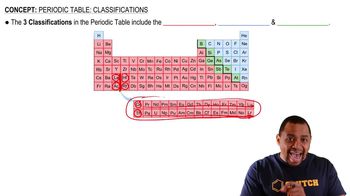
Periodic Table Classifications

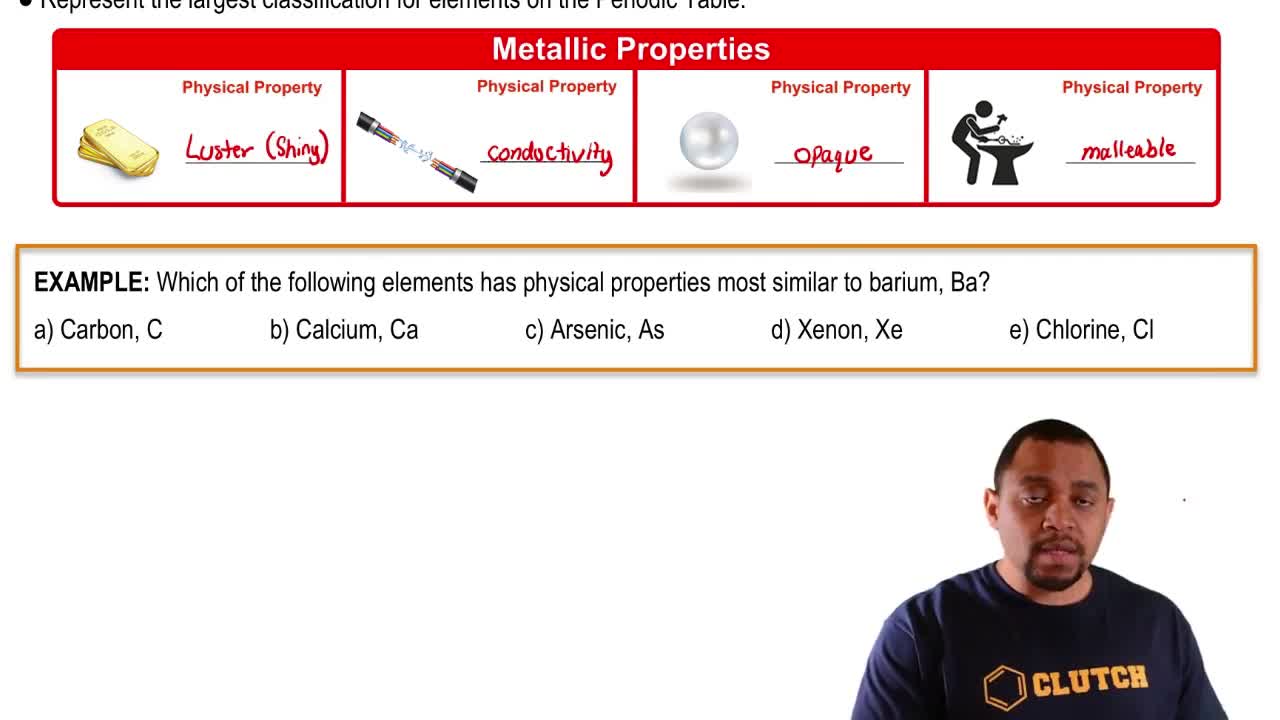
Element Classification

Elements are classified as metals, nonmetals, or semimetals (metalloids) based on their physical and chemical properties. Metals are typically conductive, malleable, and ductile, while nonmetals are usually poor conductors and more brittle. Semimetals exhibit properties of both metals and nonmetals, making their classification essential for understanding their behavior in reactions.
Video consigliato:
Percorso guidato
01:39
Element Classification Example

Group 6A Elements

Group 6A of the periodic table, also known as the chalcogens, includes elements like oxygen, sulfur, and selenium. These elements typically have six valence electrons and can form various compounds, often exhibiting nonmetallic characteristics. Identifying the specific element in period 4, group 6A is key to determining its classification and properties.
Video consigliato:
Percorso guidato
01:32
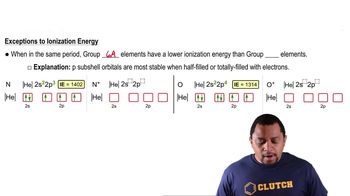
Group 6A vs. Group 5A Elements
Pratica correlata
Domanda del libro di testo
Which experiment and subsequent observation led to the discovery that atoms contain negatively charged particles, now known as electrons? (LO 2.10–2.12) (a) Oil is sprayed into a chamber and the speed at which the oil droplets fall is measured with and without an applied voltage. X rays in the chamber knock electrons out of air molecules. The electrons stick to the oil pro-ducing an overall negative charge on the drops. Adjusting the voltage changes the speed at which the negatively charged oil droplets fall. (b) When a high voltage is applied across metal electrodes at opposite ends of a sealed glass tube, a cathode ray is produced. The cathode ray is repelled by a negatively charged plate. (c) A radioactive substance emits alpha particles, which are directed at a thin gold foil. Most of the alpha par-ticles pass through the foil, but a few alpha particles are slightly deflected and some even bounce back toward the radioactive source. (d) The mass of different elements in a pure chemical com-pound are measured. Different samples of the compound always contains the same proportion of elements by mass.
451
views
Domanda del libro di testo
Refer to a periodic table. Which pair of elements do you expect to be most similar in their chemical properties? (LO 2.3) (a) K and Cu (b) O and Se (c) Be and B (d) Rb and Sr
901
views
1
rank
Domanda del libro di testo
A compound containing sulfur and fluorine contains 8.00 g of S and 9.50 g of F. Which combination of S and F masses represents a different compound that obeys the Law of Mul-tiple Proportions? (LO 2.8) (a) 32.0 g of S and 38.0 g of F (b) 4.00 g of S and 4.75 g of F (c) 8.00 g of S and 10.5 g of F (d) 16.0 g of S and 57.0 g of F
711
views
Domanda del libro di testo
Which description of an element is incorrectly matched with its location in the periodic table? (LO 2.5–2.6)

(a) Element 3—An element in the transition metal group that is a good conductor of electricity. (b) Element 2—An element that is in the halogen group and does not conduct electricity. (c) Element 4—An element in alkali metal group that is found in its pure form in nature. (d) Element 1—An element that is a solid at room tempera-ture, brittle, and a poor conductor of electricity.
453
views