Ch.2 - Atoms, Molecules & Ions
McMurry - Chemistry 8th Edition
McMurry8th EditionChemistryISBN: 9781292336145Non è quello che usi tu?Cambia libro di testo
Capitolo 2, Problema 99

Iodine has a lower atomic mass than tellurium (126.90 for iodine, 127.60 for tellurium) even though it has a higher atomic number (53 for iodine, 52 for tellurium). Explain.

Guida verificata passo dopo passo
1
Understand that atomic mass is not solely determined by the number of protons and neutrons in the nucleus, but also by the isotopic composition of the element.
Recognize that the atomic mass listed on the periodic table is the weighted average of all the isotopes of that element occurring in nature.
Consider that tellurium (Te) has several stable isotopes, and some of these isotopes have a relatively high mass which influences the average atomic mass.
Note that iodine (I), on the other hand, primarily exists as one stable isotope, I-127, which closely matches its atomic mass.
Conclude that the presence of heavier isotopes in natural tellurium compared to iodine leads to tellurium having a slightly higher average atomic mass despite having a lower atomic number.

Risposta video verificata per un problema simile:

Questa soluzione video è stata consigliata dai nostri tutor come utile per risolvere questo problema.
Durata del video:
3m

Concetti chiave

Ecco i concetti essenziali che devi comprendere per rispondere correttamente alla domanda.

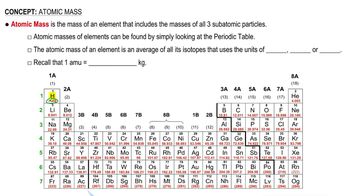
Atomic Mass vs. Atomic Number

Atomic mass is the weighted average mass of an element's isotopes, measured in atomic mass units (amu), while atomic number is the number of protons in an atom's nucleus. The atomic mass reflects both protons and neutrons, which can vary among isotopes, whereas the atomic number is unique to each element and determines its identity.
Video consigliato:

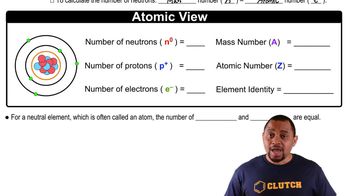
Isotopes and Neutron Count

Isotopes are variants of a chemical element that have the same number of protons but different numbers of neutrons. This variation in neutron count affects the atomic mass, as isotopes with more neutrons will have a higher mass. For iodine and tellurium, the presence of heavier isotopes can lead to differences in their average atomic masses despite their atomic numbers.
Video consigliato:

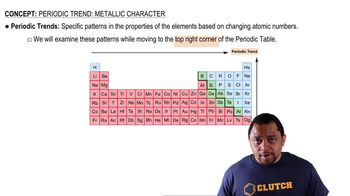
Periodic Trends

Periodic trends refer to patterns observed in the periodic table, such as atomic size, ionization energy, and atomic mass. As you move across a period, atomic number increases, but the addition of neutrons can lead to unexpected atomic masses. Understanding these trends helps explain why iodine, with a higher atomic number, has a lower atomic mass than tellurium.
Video consigliato:
Percorso guidato
00:38
Periodic Trends