Ch.2 - Atoms, Molecules & Ions
McMurry - Chemistry 8th Edition
McMurry8th EditionChemistryISBN: 9781292336145Non è quello che usi tu?Cambia libro di testo
Capitolo 2, Problema 35b

What is the atomic number of the blue element?

Guida verificata passo dopo passo
1
Identify the 'blue element' by determining which element is being referred to. This could be based on a periodic table color-coding system or a specific context where elements are color-coded.
Once the element is identified, locate it on the periodic table.
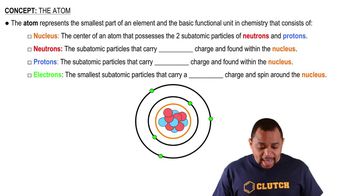
The atomic number of an element is the number of protons in the nucleus of an atom of that element.
Find the atomic number, which is usually located above the element symbol on the periodic table.
Verify the element's identity and atomic number by cross-referencing with reliable sources or periodic tables.

Risposta video verificata per un problema simile:

Questa soluzione video è stata consigliata dai nostri tutor come utile per risolvere questo problema.
Durata del video:
1m

Concetti chiave

Ecco i concetti essenziali che devi comprendere per rispondere correttamente alla domanda.

Atomic Number

The atomic number is a fundamental property of an element, defined as the number of protons in the nucleus of an atom. It determines the element's identity and its position in the periodic table. For example, hydrogen has an atomic number of 1, while carbon has an atomic number of 6.
Video consigliato:

Element Identification

Elements are pure substances that cannot be broken down into simpler substances by chemical means. Each element is represented by a unique symbol and is characterized by its atomic number. Identifying an element often involves recognizing its color, state, and other physical properties, such as the blue color mentioned in the question.
Video consigliato:
Percorso guidato
01:15
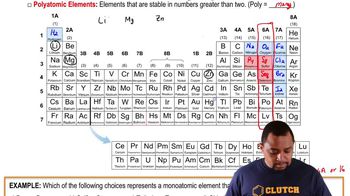
Chalcogen Identification Example

Periodic Table

The periodic table is a systematic arrangement of elements based on their atomic number, electron configuration, and recurring chemical properties. Elements are organized in rows (periods) and columns (groups), which helps predict their behavior in chemical reactions. The blue element referred to in the question can be located on this table, aiding in its identification.
Video consigliato:
Percorso guidato
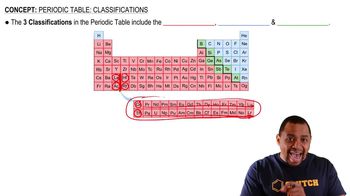
02:40
Periodic Table Classifications