
Ch.2 - Atoms, Molecules & Ions
McMurry - Chemistry 8th Edition
McMurry8th EditionChemistryISBN: 9781292336145Non è quello che usi tu?Cambia libro di testo
Capitolo 2, Problema 77

What is the law of multiple proportions, and how does Dalton's atomic theory account for it?

Guida verificata passo dopo passo
1
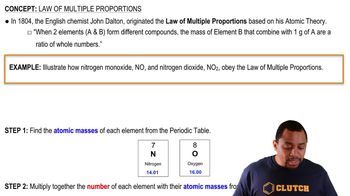
The law of multiple proportions states that when two elements combine to form more than one compound, the masses of one element that combine with a fixed mass of the other are in the ratio of small whole numbers.
To understand this, consider two elements, A and B, forming two different compounds. If compound 1 has a mass ratio of A to B as m1:n1 and compound 2 has a mass ratio of A to B as m2:n2, then the ratio (m1/m2) to (n1/n2) will be a simple whole number.
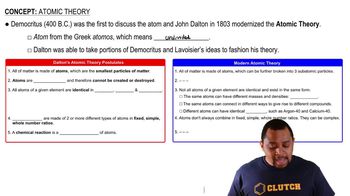
Dalton's atomic theory explains this by proposing that elements are composed of indivisible atoms, and compounds are formed by the combination of atoms in fixed ratios.
According to Dalton, atoms of a given element are identical in mass and properties, and chemical reactions involve the rearrangement of these atoms.
Thus, the law of multiple proportions is explained by the fact that atoms combine in simple whole-number ratios, leading to the observed mass ratios in different compounds.

Risposta video verificata per un problema simile:

Questa soluzione video è stata consigliata dai nostri tutor come utile per risolvere questo problema.
Durata del video:
2m

Concetti chiave

Ecco i concetti essenziali che devi comprendere per rispondere correttamente alla domanda.

Law of Multiple Proportions

The law of multiple proportions states that when two elements form more than one compound, the ratios of the masses of one element that combine with a fixed mass of the other element can be expressed as simple whole numbers. This principle highlights the discrete nature of chemical compounds and supports the idea that elements combine in specific ratios to form different substances.
Video consigliato:
Percorso guidato
03:32
Law of Multiple Proportions

Dalton's Atomic Theory

Dalton's atomic theory posits that matter is composed of indivisible atoms, which combine in fixed ratios to form compounds. This theory provides a framework for understanding chemical reactions and the formation of compounds, as it explains how different combinations of atoms lead to the creation of distinct substances, thereby supporting the law of multiple proportions.
Video consigliato:
Percorso guidato
05:22
Dalton's Atomic Theory

Atomic Mass and Ratios

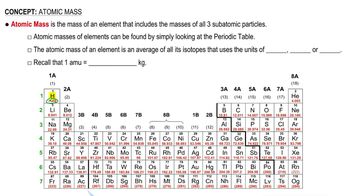
Understanding atomic mass is crucial for applying the law of multiple proportions, as it allows for the calculation of mass ratios between elements in different compounds. By comparing the masses of the elements involved, one can demonstrate that the ratios of the masses of one element that combine with a fixed mass of another are whole numbers, reinforcing the principles outlined in Dalton's atomic theory.
Video consigliato: