Ch.2 - Atoms, Molecules & Ions
McMurry - Chemistry 8th Edition
McMurry8th EditionChemistryISBN: 9781292336145Non è quello che usi tu?Cambia libro di testo
Capitolo 2, Problema 60

Where in the periodic table are the metallic elements found? Where are the nonmetallic elements found?Color-coded periodic table highlighting metallic and nonmetallic elements.

Guida verificata passo dopo passo
1
Observe the periodic table image provided, which is color-coded to distinguish between metallic and nonmetallic elements.
Note that the elements colored in blue represent the metallic elements.
Notice that the elements colored in red represent the nonmetallic elements.
Identify that the elements colored in green represent the metalloids, which have properties intermediate between metals and nonmetals.
Conclude that metallic elements are primarily found on the left side and in the center of the periodic table, while nonmetallic elements are found on the right side of the periodic table.

Risposta video verificata per un problema simile:

Questa soluzione video è stata consigliata dai nostri tutor come utile per risolvere questo problema.
Durata del video:
1m

Concetti chiave

Ecco i concetti essenziali che devi comprendere per rispondere correttamente alla domanda.

Metallic Elements

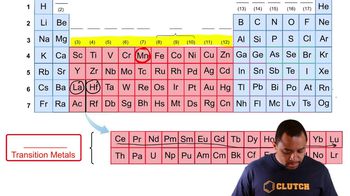
Metallic elements are primarily found on the left side and in the center of the periodic table. They are characterized by their ability to conduct electricity and heat, malleability, ductility, and a shiny appearance. Common examples include iron, copper, and gold. The majority of elements in the periodic table are metals.
Video consigliato:
Percorso guidato
03:30
Transition Metals and Representative Elements

Nonmetallic Elements

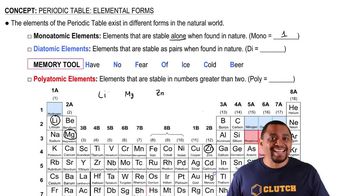
Nonmetallic elements are located on the right side of the periodic table, with the exception of hydrogen, which is positioned at the top left. These elements are generally poor conductors of heat and electricity and can be gases, liquids, or solids at room temperature. Examples include oxygen, nitrogen, and sulfur. Nonmetals tend to gain electrons during chemical reactions.
Video consigliato:
Percorso guidato
02:35
Elemental Forms of Elements

Periodic Table Structure

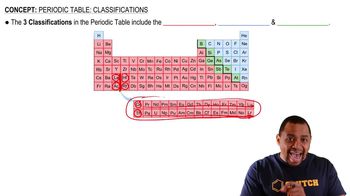
The periodic table is organized in a way that groups elements with similar properties together. Rows, known as periods, indicate the number of electron shells, while columns, called groups, reflect the number of valence electrons. This structure helps predict the behavior of elements, including their metallic or nonmetallic characteristics, based on their position in the table.
Video consigliato:
Percorso guidato
02:40
Periodic Table Classifications