Ch.2 - Atoms, Molecules & Ions
McMurry - Chemistry 8th Edition
McMurry8th EditionChemistryISBN: 9781292336145Non è quello che usi tu?Cambia libro di testo
Capitolo 2, Problema 12

Which of the following compounds would you expect to have covalent bonds? (LO 2.20) (a) Na2O (b) PBr3 (c) CaBr2 (d) MgS

Guida verificata passo dopo passo
1
Step 1: Understand that covalent bonds are formed when two nonmetals share electrons. This is in contrast to ionic bonds, which are formed when a metal and a nonmetal exchange electrons.
Step 2: Identify the type of elements in each compound. Sodium (Na) and Oxygen (O) in Na2O are a metal and a nonmetal, respectively. Phosphorus (P) and Bromine (Br) in PBr3 are both nonmetals. Calcium (Ca) and Bromine (Br) in CaBr2 are a metal and a nonmetal, respectively. Magnesium (Mg) and Sulfur (S) in MgS are a metal and a nonmetal, respectively.
Step 3: Based on the types of elements in each compound, predict the type of bond. Na2O, CaBr2, and MgS are likely to have ionic bonds because they are composed of a metal and a nonmetal. PBr3 is likely to have covalent bonds because it is composed of nonmetals only.
Step 4: Therefore, the compound that you would expect to have covalent bonds is PBr3.

Risposta video verificata per un problema simile:

Questa soluzione video è stata consigliata dai nostri tutor come utile per risolvere questo problema.
Durata del video:
1m

Concetti chiave

Ecco i concetti essenziali che devi comprendere per rispondere correttamente alla domanda.

Covalent Bonds

Covalent bonds are formed when two atoms share one or more pairs of electrons, typically between nonmetals. This type of bonding allows atoms to achieve a full outer shell of electrons, leading to greater stability. Compounds with covalent bonds often have lower melting and boiling points compared to ionic compounds and can exist as gases, liquids, or solids at room temperature.
Video consigliato:

Ionic vs. Covalent Compounds

Ionic compounds are formed through the transfer of electrons from one atom to another, resulting in the formation of charged ions that attract each other. In contrast, covalent compounds involve the sharing of electrons. Understanding the difference between these types of bonding is crucial for predicting the properties and behaviors of various compounds, including their solubility and conductivity.
Video consigliato:
Percorso guidato
02:11
Ionic Compounds Naming

Electronegativity

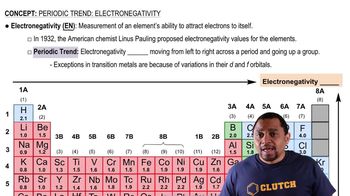
Electronegativity is a measure of an atom's ability to attract and hold onto electrons in a bond. In general, nonmetals have higher electronegativities than metals, which influences whether a bond will be ionic or covalent. When two atoms with similar electronegativities bond, they are more likely to form covalent bonds, while a significant difference typically leads to ionic bonding.
Video consigliato:
Percorso guidato
02:10
Electronegativity Trends