
Ch.2 - Atoms, Molecules & Ions
McMurry - Chemistry 8th Edition
McMurry8th EditionChemistryISBN: 9781292336145Non è quello che usi tu?Cambia libro di testo
Capitolo 2, Problema 41a

Which of the following three drawings represents a neutral Na atom? (a) (b) (c)

Guida verificata passo dopo passo
1
Identify the number of protons in a neutral Na atom, which is 11, as it corresponds to the atomic number of sodium.
Recognize that a neutral atom has an equal number of protons and electrons. Therefore, a neutral Na atom should also have 11 electrons.
Examine each drawing to determine the number of electrons depicted.
Compare the number of electrons in each drawing to the number of protons (11) to identify which drawing represents a neutral Na atom.
Select the drawing where the number of electrons equals the number of protons, indicating a neutral Na atom.

Risposta video verificata per un problema simile:

Questa soluzione video è stata consigliata dai nostri tutor come utile per risolvere questo problema.
Durata del video:
2m

Concetti chiave

Ecco i concetti essenziali che devi comprendere per rispondere correttamente alla domanda.

Atomic Structure

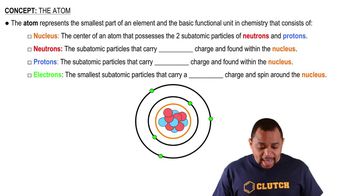
An atom consists of a nucleus containing protons and neutrons, surrounded by electrons in various energy levels. For a neutral atom, the number of protons equals the number of electrons, balancing the positive and negative charges. Understanding this structure is essential to identify the characteristics of specific elements, such as sodium (Na).
Video consigliato:

Electron Configuration

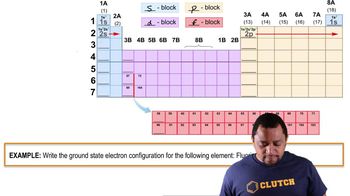
Electron configuration describes the distribution of electrons in an atom's energy levels and orbitals. For a neutral sodium atom, which has 11 electrons, the electron configuration is 1s² 2s² 2p⁶ 3s¹. This configuration helps determine the atom's chemical properties and its representation in drawings, as the outermost electron plays a crucial role in bonding.
Video consigliato:
Percorso guidato
01:33
Electron Configuration Example

Neutral Atoms

A neutral atom has an equal number of protons and electrons, resulting in no overall charge. In the case of sodium, it has 11 protons and 11 electrons, making it neutral. Recognizing the significance of charge balance is vital when interpreting drawings of atoms, as any discrepancy in the number of protons and electrons would indicate an ion rather than a neutral atom.
Video consigliato: