Ch.2 - Atoms, Molecules & Ions
McMurry - Chemistry 8th Edition
McMurry8th EditionChemistryISBN: 9781292336145Non è quello che usi tu?Cambia libro di testo
Capitolo 2, Problema 103

Write symbols for the following isotopes: (a) Z = 58 and A = 140 (b) Z = 27 and A = 60

Guida verificata passo dopo passo
1
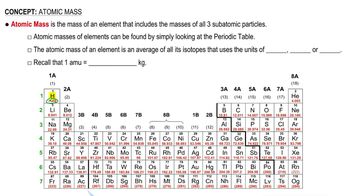
Identify the element using the atomic number (Z). For (a), Z = 58 corresponds to the element Cerium (Ce) on the periodic table.
Write the isotope notation for Cerium with the given mass number (A = 140). The notation is written as \( ^{140}_{58}Ce \).
Identify the element using the atomic number (Z). For (b), Z = 27 corresponds to the element Cobalt (Co) on the periodic table.
Write the isotope notation for Cobalt with the given mass number (A = 60). The notation is written as \( ^{60}_{27}Co \).
Review the isotope notation: The superscript (A) is the mass number, and the subscript (Z) is the atomic number, followed by the element symbol.

Risposta video verificata per un problema simile:

Questa soluzione video è stata consigliata dai nostri tutor come utile per risolvere questo problema.
Durata del video:
2m

Concetti chiave

Ecco i concetti essenziali che devi comprendere per rispondere correttamente alla domanda.

Isotopes

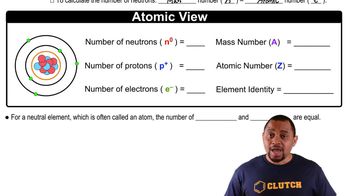
Isotopes are variants of a particular chemical element that have the same number of protons (atomic number, Z) but different numbers of neutrons, resulting in different mass numbers (A). For example, carbon-12 and carbon-14 are isotopes of carbon, with 6 and 8 neutrons, respectively.
Video consigliato:

Atomic Number (Z)

The atomic number (Z) is the number of protons in the nucleus of an atom, which defines the element and its position in the periodic table. It determines the chemical properties of the element and its identity; for instance, an element with Z = 27 is cobalt.
Video consigliato:

Mass Number (A)

The mass number (A) is the total number of protons and neutrons in an atom's nucleus. It is used to distinguish between different isotopes of the same element. For example, if an element has Z = 27 and A = 60, it has 27 protons and 33 neutrons (60 - 27 = 33).
Video consigliato: