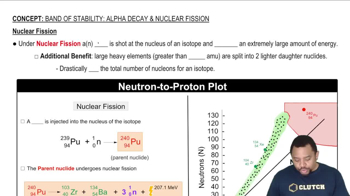
How much energy (in kJ/mol) is produced in the following fission reaction of plutonium-239?
Guida verificata passo dopo passo
1
Identify the fission reaction for plutonium-239. Write down the balanced nuclear equation including the products formed.
Determine the mass of the reactants and the mass of the products from the nuclear equation. Use the atomic masses from a reliable source or a periodic table.
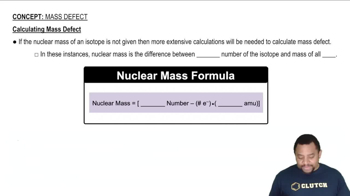
Calculate the mass defect by subtracting the total mass of the products from the total mass of the reactants.
Convert the mass defect from atomic mass units (amu) to kilograms (kg) using the conversion factor (1 amu = 1.66053906660 x 10^-27 kg).
Use Einstein's equation, E=mc^2, where E is the energy, m is the mass defect in kg, and c is the speed of light in vacuum (approximately 3.00 x 10^8 m/s), to calculate the energy released in joules. Then convert the energy from joules to kilojoules (1 Joule = 0.001 kJ) and finally to kJ/mol.
Risposta video verificata per un problema simile:
Questa soluzione video è stata consigliata dai nostri tutor come utile per risolvere questo problema.
Durata del video:
6m
Guarda un video:
0 Commenti
Concetti chiave
Ecco i concetti essenziali che devi comprendere per rispondere correttamente alla domanda.
Nuclear Fission
Nuclear fission is a process in which a heavy nucleus, such as plutonium-239, splits into two or more lighter nuclei, along with the release of energy. This reaction typically occurs when the nucleus absorbs a neutron, becoming unstable and breaking apart. The energy released during fission is due to the conversion of mass into energy, as described by Einstein's equation E=mc².
In chemical and nuclear reactions, energy can be released or absorbed. For fission reactions, the energy produced is often measured in kilojoules per mole (kJ/mol). This energy release is a result of the strong nuclear forces that bind protons and neutrons in the nucleus, and when these bonds are broken, energy is released, which can be harnessed for power generation.
The energy produced in a fission reaction can be calculated using the mass defect, which is the difference between the mass of the original nucleus and the total mass of the resulting fragments. This mass defect is converted into energy using Einstein's equation E=mc². Understanding how to calculate the mass defect is essential for determining the energy output of the fission reaction.


 Guida verificata passo dopo passo
 03:29
03:29