
Ch.20 - Nuclear Chemistry
McMurry - Chemistry 8th Edition
McMurry8th EditionChemistryISBN: 9781292336145Non è quello che usi tu?Cambia libro di testo
Capitolo 20, Problema 8

Identify the true statement about nuclear power plants and nuclear weapons. (a) Nuclear power plants and nuclear weapons both use uranium enriched to about 90% U-235. (b) Nuclear power plants emit large amounts of CO2 just like coal burning power plants. (c) The United States produces less than 1% of its electrical power from nuclear energy. (d) A nuclear weapon explodes when two pieces of fission-able uranium-235 are pushed together to reach a critical mass.

Guida verificata passo dopo passo
1
Understand the difference between nuclear power plants and nuclear weapons in terms of their purpose and the materials they use.
Recognize that nuclear power plants use nuclear fission to generate electricity, typically using uranium that is enriched to about 3-5% U-235, not 90%.
Acknowledge that nuclear power plants do not emit CO2 during the nuclear fission process, though there are emissions associated with other aspects of their lifecycle.
Research the percentage of electrical power produced by nuclear energy in the United States to verify the accuracy of the given statement.
Learn about the mechanism of a nuclear weapon, specifically how achieving critical mass of fissionable material like uranium-235 leads to an explosion.

Risposta video verificata per un problema simile:

Questa soluzione video è stata consigliata dai nostri tutor come utile per risolvere questo problema.
Durata del video:
1m

Concetti chiave

Ecco i concetti essenziali che devi comprendere per rispondere correttamente alla domanda.

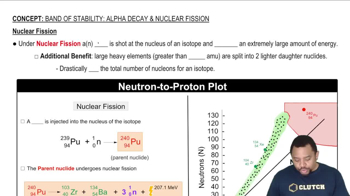
Nuclear Fission

Nuclear fission is the process by which a heavy nucleus, such as uranium-235, splits into two smaller nuclei along with the release of energy and neutrons. This reaction is fundamental to both nuclear power plants and nuclear weapons, but the conditions and materials used differ significantly. In power plants, controlled fission generates energy for electricity, while in weapons, an uncontrolled chain reaction leads to an explosive release of energy.
Video consigliato:
Percorso guidato
03:29
Band of Stability: Nuclear Fission

Uranium Enrichment

Uranium enrichment is the process of increasing the percentage of the isotope uranium-235 in uranium ore. For nuclear power plants, uranium is typically enriched to about 3-5% U-235, which is sufficient for sustaining a controlled fission reaction. In contrast, nuclear weapons require uranium enriched to about 90% U-235 to achieve the rapid, uncontrolled fission necessary for an explosion.
Video consigliato:
Percorso guidato
03:29
Electron Capture & Positron Emission Reaction Example

Critical Mass

Critical mass is the minimum amount of fissile material needed to maintain a nuclear chain reaction. In the context of nuclear weapons, achieving critical mass involves bringing together enough fissionable material, such as uranium-235, to initiate an explosive reaction. This concept is crucial for understanding how nuclear weapons function, as it determines the design and efficiency of the weapon.
Video consigliato: