Ch.20 - Nuclear Chemistry
McMurry - Chemistry 8th Edition
McMurry8th EditionChemistryISBN: 9781292336145Non è quello che usi tu?Cambia libro di testo
Capitolo 20, Problema 101

Molybdenum-99 is formed by neutron bombardment of a naturally occurring isotope of Mo. If one neutron is absorbed and no by-products are formed, what is the starting isotope?

Guida verificata passo dopo passo
1
Identify the naturally occurring isotopes of molybdenum (Mo). These include Mo-92, Mo-94, Mo-95, Mo-96, Mo-97, Mo-98, and Mo-100.
Understand that neutron bombardment involves the absorption of a neutron by the nucleus of an atom, which increases the mass number by 1 while the atomic number remains unchanged.
Set up the equation for the nuclear reaction: \( ^A_{42}\text{Mo} + ^1_0\text{n} \rightarrow ^{99}_{42}\text{Mo} \), where \( A \) is the mass number of the starting isotope.
Solve for \( A \) by recognizing that the mass number of the starting isotope plus 1 (from the neutron) should equal 99, the mass number of the product isotope.
Determine which naturally occurring isotope of molybdenum has a mass number that, when increased by 1, results in 99.

Concetti chiave

Ecco i concetti essenziali che devi comprendere per rispondere correttamente alla domanda.

Isotopes

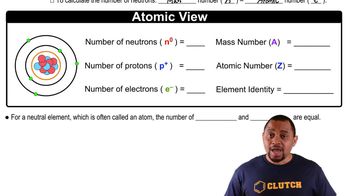
Isotopes are variants of a particular chemical element that have the same number of protons but different numbers of neutrons. This results in different atomic masses for the isotopes of the same element. Understanding isotopes is crucial for identifying the starting material in nuclear reactions, as the specific isotope will determine the products formed after neutron bombardment.
Video consigliato:

Neutron Bombardment

Neutron bombardment is a nuclear reaction where neutrons are directed at a target nucleus, leading to various outcomes such as the formation of new isotopes. In this process, the absorption of a neutron can change the atomic mass of the nucleus without altering its charge, which is essential for determining the resulting isotope after the reaction.
Video consigliato:
Percorso guidato
01:38
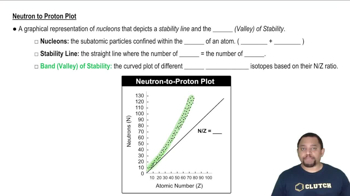
Neutron-to-Proton Plot

Nuclear Reactions

Nuclear reactions involve changes in an atom's nucleus and can result in the transformation of one element into another or the formation of isotopes. In the context of the question, understanding how neutron absorption affects the nucleus is key to identifying the original isotope that leads to the formation of Molybdenum-99, as it requires knowledge of the specific nuclear changes that occur.
Video consigliato:
Percorso guidato
02:06
Nuclear Binding Energy